How Product Event Streams Replace Time-Based Drips as the Control Plane for Onboarding Email Logic
Behavior-based triggers replace schedules as the engine for onboarding email.
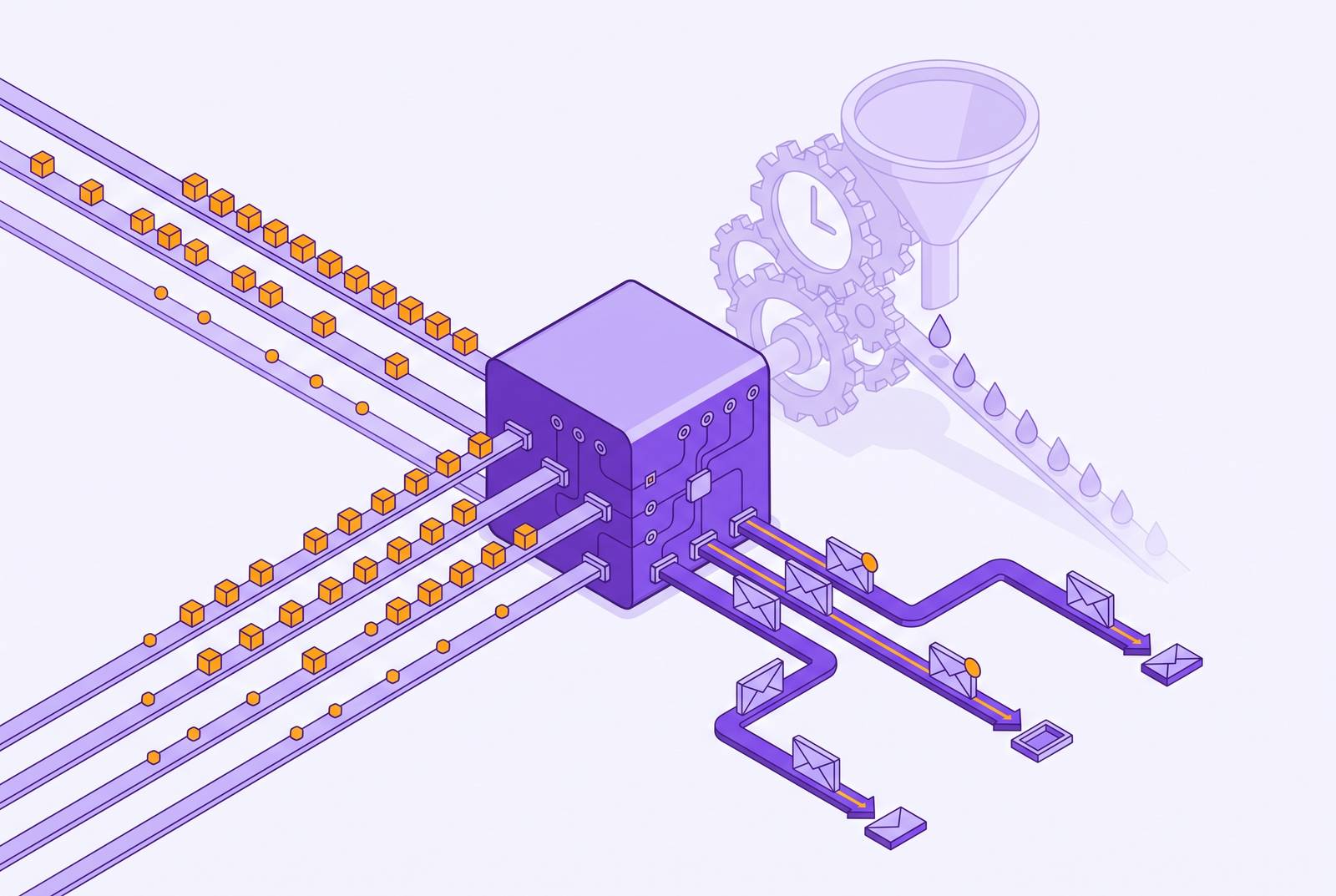
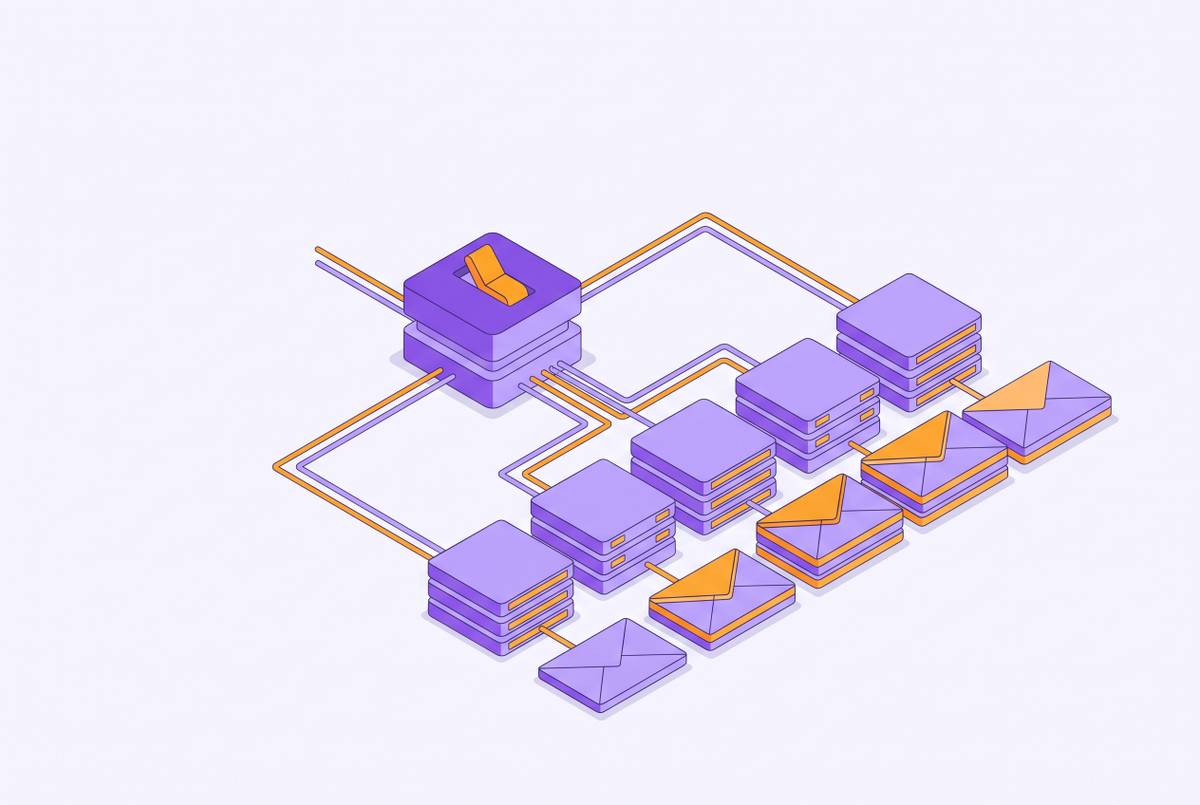
The shift from time-based drips to product-event-driven onboarding is an architectural change, not a copywriting upgrade. Product event streams become the actual decision engine that determines whether, when, and what to send. The calendar stops being the authority. The user's own behavior takes its place.
Why time was never the right signal for onboarding decisions
A "finish setup" email lands in an inbox at hour 72, and the person who receives it completed setup at hour two. The calendar advanced, so the email advanced. The message ignores reality, and the person who reads it has now been trained to ignore future messages from the same sender. This is the cost of building onboarding logic on elapsed time, and it shows up in two failure modes that reinforce each other.
The first failure is sending a nudge for a task that is already done. The second is sending a "pro tip" to someone who has not logged in a second time. The first message lands on someone who moved faster than the schedule. The second lands on someone who moved slower. Both fail for the same reason: relevance requires knowing where the person is, not when they signed up. A user who mutes early emails never receives the ones that would have helped.
Time-based drips were always a proxy. The contract was simple: welcome on day 0, tips on day 3, check-in on day 7. Elapsed time stood in for product progress because product progress was not observable at send time. The tool was cheap to build, which is why the pattern spread, not because elapsed time predicted user readiness.
A sequence with conditional subject lines or merge tags bolted onto a fixed schedule is still a time-based drip. The distinction is whether the calendar or the user's actual progress drives the cadence. Teams that decorate a fixed schedule have not changed the control plane. They have decorated it.
What a product event stream actually is and why it changes the governing contract
A product event stream is a real-time log of discrete user actions emitted by the product itself. Each event is a timestamped signal: user.signed_up, user.completed_setup, user.reached_milestone_1, three days of silence. These are observable facts, not inferences from elapsed time. Making this stream the input to send decisions changes who holds authority over the onboarding sequence. The product holds it, not the calendar.
The governing contract shifts. Instead of "send email N on day N," the contract becomes "send the next message when the user's state changes, or when it fails to change." Static, time-based onboarding treats users as moving through a predictable sequence. Event-driven onboarding treats each user as progressing at their own pace, based on their actual needs. Users who move fast get relevant content faster. Users who are stuck get help when they need it. The sequence adapts without anyone writing a new campaign.
The mechanism is direct. A product event updates a contact property or triggers a webhook, and the email automation listens for that change rather than for the clock. Event to property update to branch evaluation to send or suppress: this is the loop that replaces the calendar. Inactivity is also an event. Three days without user.completed_setup is a signal the sequence can act on, just as a completed milestone is.
An email that arrives because the user just hit a wall is relevant in a way a Tuesday-morning broadcast cannot be. A message grounded in what the person just did or just failed to do carries information the recipient knows is current. Platform operators consistently report that the behavior-based approach outperforms time-based on engagement. The direction is well-attested across multiple ESP and PLG-tool vendors. The specific multipliers are vendor-reported and should be treated as reasons to test, not board-deck figures.
The data model an event-driven control plane requires
Event-driven onboarding logic only works if the product emits reliable, instrumentable events that capture the milestones that actually predict user success. Most teams skip this definition step. They build sequences around "finished the tour" rather than a specific observable action that correlates with long-term retention. Those teams are solving the wrong problem.
The activation definition must precede instrumentation. You cannot instrument a milestone you have not named. Pick the single observable action that best correlates with long-term retention. The examples from practice are specific: "created and shared one project," not "completed onboarding." Or "closed one ticket with the AI agent," not "signed up." One specific action, instrumented, is the north star every onboarding decision points back to. This is the 2026 standard, according to Flowjam's onboarding benchmark.
The definition step explains why teams often mistake behavior-based segmentation for event-driven control. Tagging users after the fact is not the same as linking product analytics to backend state at send time. True event-driven onboarding requires the system to answer "should this person receive this message right now" based on both what they have done and what they have configured. Userlens operates on this principle: it reads current database state alongside behavioral history to determine not just when to send, but whether the message is grounded in something the person actually needs right now.
In B2B SaaS, the data model must distinguish people from accounts. Individual user behavior and account-level state are different signals that drive different decisions. B2B products involve multiple stakeholders from the same company, each with different goals, roles, and progress states. Onboarding logic that addresses only individual users misses the account dimension. An admin completing setup and an end-user completing setup are different events with different downstream implications. Conflating them produces wrong branch evaluations. Role-based segmentation at signup should route designers, admins, and developers onto different event paths from the start.
Current database state tells you what is configured. Event history tells you what was actually used. The gap between the two is where onboarding failures hide. Connecting a backend database with product analytics is what makes that gap visible. Userlens's architecture connects current account state, meaning plans, roles, and configuration, with behavior over time. The gap between what should be happening and what is happening becomes the trigger. No new tracking plan is required. The state-plus-behavior signal comes from data the team already has.
How the send decision actually works: trigger, branch, suppress
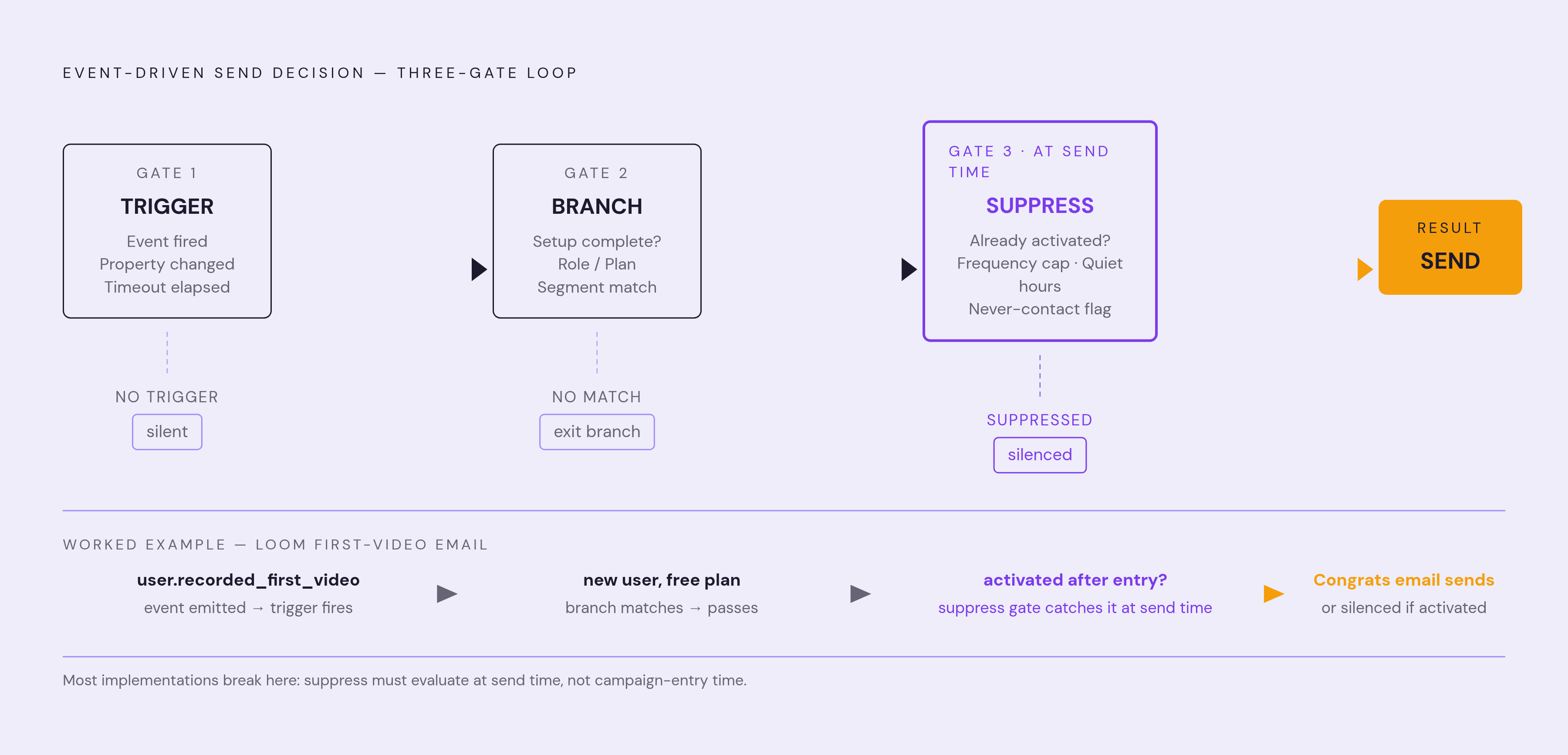
The event-driven send decision is a three-gate loop: trigger, branch, suppress. Suppression is as important as triggering, yet almost always built last. The trigger is a product event firing, a contact property changing, or an expected event failing to appear within a time window. The branch evaluates current state: did the user complete setup, what role are they, what plan are they on. It routes them to the right message or to silence.
Loom's first-milestone email is a clean example of a trigger in action. The message fires the moment the user records their first video, not on a schedule. The subject line, "Congrats, you recorded your first video on Loom 🥳," arrives because an event happened. The user knows immediately why the message arrived. The relevance is mechanical.
Suppression is where most implementations break. It is built as an afterthought rather than as a first-class gate. Getting suppression wrong is the fastest way to make a good sequence feel like spam. The suppress-if-already-done check must evaluate at send time, not at campaign-entry time. A user can activate between when they entered the branch and when the message fires. Frequency caps, quiet hours, and never-contact flags belong at the send gate for the same reason: state can change between evaluation and delivery.
The sequence anatomy that falls out of this loop is simple. Each email has exactly one job, one CTA, and one triggering condition. Multiple CTAs create decision fatigue and dilute the activation signal. The practical pattern runs like this: welcome fires within minutes of user.signed_up. Setup prompt fires when setup is incomplete at the 24-hour mark. Feature education fires on first entry into a relevant product area. Milestone celebration fires on user.reached_milestone_1. Trial-end warning fires on a billing event, not a date. The last email in the sequence is always tied to a product event.
Being in the audience does not automatically justify sending a message. A user who entered the onboarding audience three days ago may have since completed the milestone. The branch must check current state, not entry state. Sending because someone is enrolled is how broadcast logic smuggles itself back into an event-driven system.
The hybrid reality: event-gated sequences with time fallbacks
Pure event-based logic is the right target, but most production sequences run as a hybrid. Reliable event tracking takes time to establish. The cost of building behavioral branching before it is ready is a sequence that is hard to debug.
The practical recommendation is to build the time-based version first. Verify that activation events are tracked correctly. Then layer in behavioral branching. The hybrid is not a failure state. It is the realistic starting point from which teams graduate as instrumentation matures.
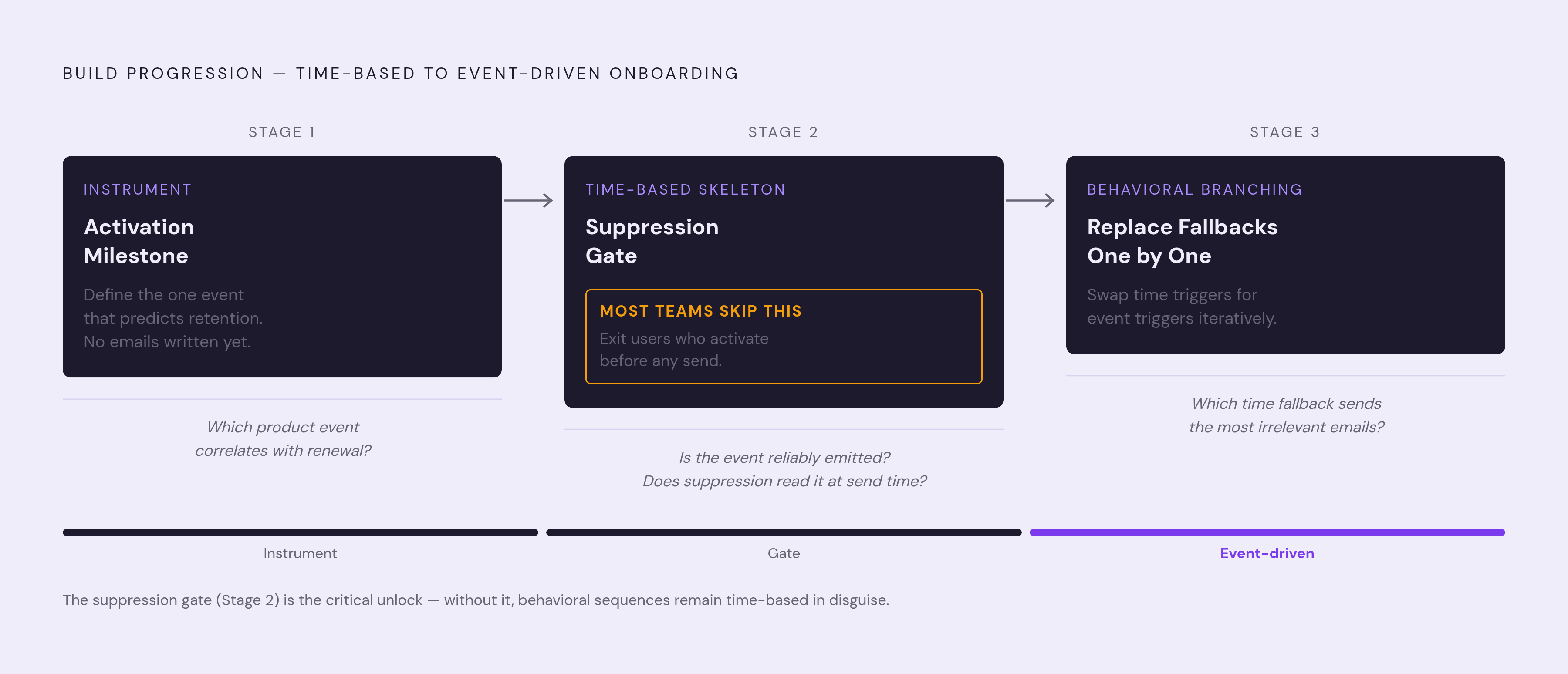
The build is three stages, each with a clear deliverable. Stage 1: define and instrument the activation milestone, the single observable event that predicts long-term retention, before writing any email. Stage 2: build the time-based skeleton and wire the suppression gate so it exits users who activate. This is functional before any branching is added. Stage 3: layer behavioral branching on top as event tracking proves reliable. Replace time fallbacks with event triggers one by one. Skipping the wiring is why most behavior-based sequences are really time-based in disguise.
Each stage has a forcing question. Stage 1 asks: what is the single product event that best correlates with a user who renews? Stage 2 asks: is that event reliably emitted, and does the suppression gate read it correctly at send time? Stage 3 asks: which time fallback is generating the most irrelevant sends, and what event should replace it? Answering the question is the gate to the next stage.
What the event stream enables that the calendar never could: per-person judgment at scale
Once the event stream is the control plane, the logical next step is not better templates. It is per-person judgment. A rule-based event trigger still asks a binary question: did event X occur? Per-person judgment asks a different question: given everything we know about this person's current state and behavior, is a message the right move right now?
The difference is not semantic. A conditional branch fires when a condition is true. Judgment skips when evidence is weak, even if the condition is technically met. B2B onboarding specifically requires reading account state alongside individual behavior. A seat on a paid plan with zero activity is a different situation from a seat on a free tier with daily logins. Neither individual user events nor account-level database state alone produces the right answer.
The scale story is what makes this approach worth the architectural investment. The attention a founder gives their first ten customers can be applied to all ten thousand. Not by writing ten thousand messages manually, but by giving each user the independent consideration that a manual review would provide. A campaign sets the approved goal, audience, guidance, and limits once. Within that approval, each eligible person is evaluated independently. Being in the audience does not automatically mean a message goes out.
Personalization grounded in product events is useful. Personalization that recites activity back to the user without connecting it to a next step is surveillance-flavored and counterproductive. A message that says "you created your first report, here's how to schedule it automatically" is useful. A message that says "we noticed you logged in three times this week" is not. Every onboarding email should push toward one activation milestone. The event stream tells you which milestone is next for this specific person.
Measuring whether the control plane is working: eligible-cohort adoption, not open rates
An event-driven onboarding system requires an event-driven measurement model. The primary question is whether users completed the target product behavior, not whether they opened the email. Measure onboarding success by activation rate and time to value. Open rates and click-through rates tell you whether the message was seen. They do not tell you whether it worked.
Apple Mail Privacy Protection inflates open rates, which makes open rate a heavily-caveated third signal. The credible engagement stack runs in this order: in-product event completion first, click-through second, open rate third. The signal hierarchy matches the control plane hierarchy. Events are the primary truth.
The metric that matters is the eligible-cohort adoption rate. What share of users who received the message and had not yet activated subsequently completed the activation event? The eligible-cohort framing separates the question "did the message work?" from "did users who were already going to activate, activate?" Measuring activation across all users who entered the sequence conflates users who would have activated anyway with users the message actually moved. The denominator should be users who were genuinely at risk of not activating.
The measurement standard for an event-driven system is repeated successful use of the activation feature, not one-time completion of an onboarding checklist. One completion can be a fluke. A second and third establish a habit. The event stream can observe both. The calendar cannot.
Distinguishing people from accounts matters in measurement too. An account where one user activated but three did not is a different retention risk from an account where all four activated. Individual-level event data is required to see this. Users who adopt a specific pair of features may convert at a dramatically higher rate than users who adopt only one. These patterns reveal which feature paths create stickiness and which are peripheral. A time-based drip cannot observe these patterns. It can only count days.
The event stream is what makes feature-combination analysis possible in the first place. You built an event-driven control plane so you could ask whether behavior actually changed. The calendar could never answer that question. The event stream can, but only if the measurement model asks it.