Seven Conditions Every Behavioral Onboarding Email Must Clear Before It Sends
Seven checks separate behavioral email systems from fast drips.
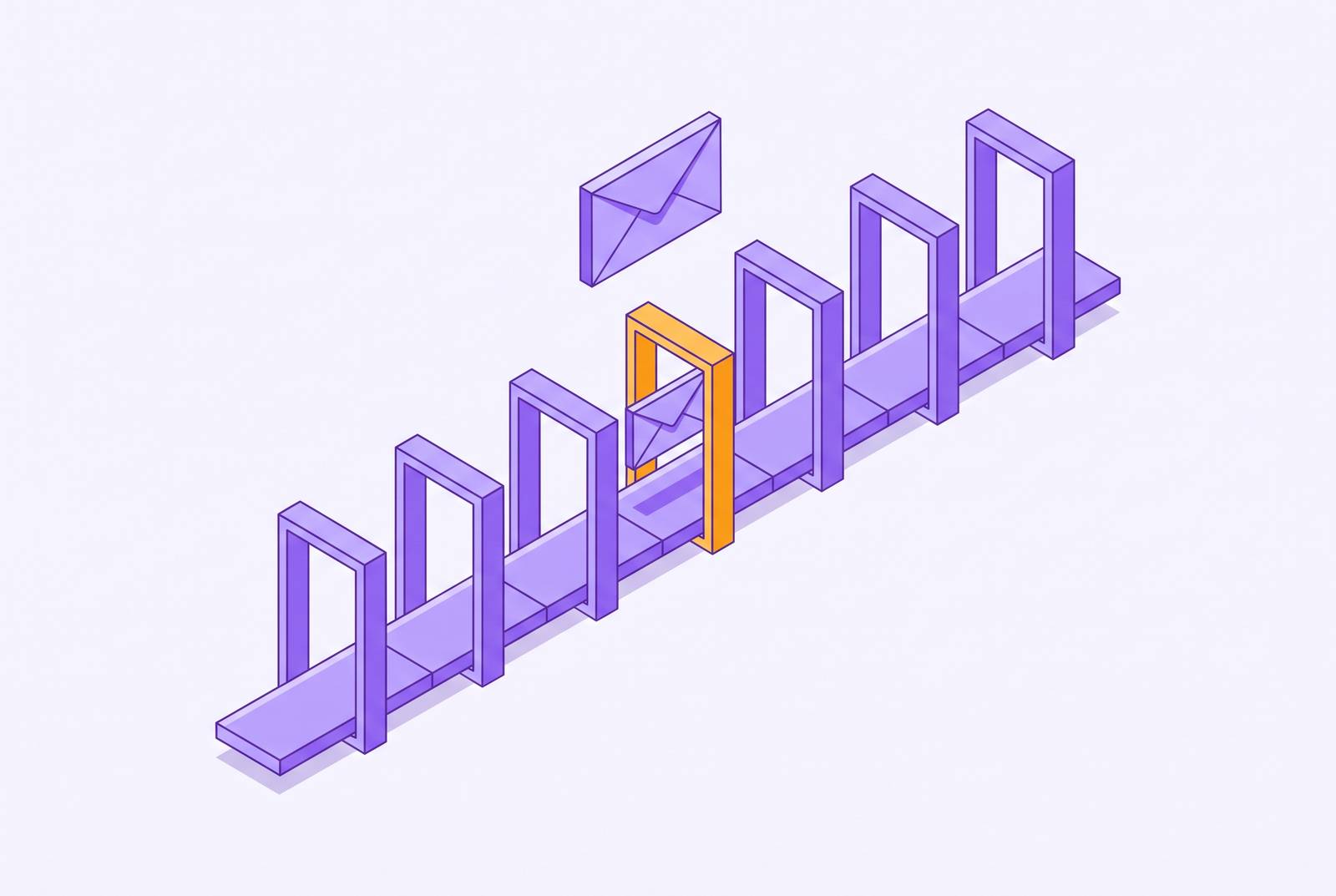
A behavior-triggered email is only as good as the checks that run between the trigger firing and the send going out, and most systems skip straight from one to the other. Seven conditions determine a justified send: eligibility, verified event state, suppression by subsequent behavior, campaign-level approval, current-state grounding, trial-versus-adoption distinction, and frequency saturation. A system that clears all seven sends when it should and skips when it shouldn't, which is the entire difference between a behavioral email system and a drip sequence wearing a behavioral label.
Why Behavior-Triggered Emails Fail
"Behavior-triggered" describes how an email starts, not whether it should have been sent. A trigger firing correctly just means the system noticed something. It says nothing about whether the recipient was the right audience, whether the behavior still matters by the time the message lands, or whether sending anything at all is the right call in that moment.
Picture two users. One logs in daily but has only ever touched a single feature. The other hasn't logged in for two weeks. Both might trip the same trigger, say, inactivity on a specific feature, but they need completely different messages. The frequent user needs a nudge toward a feature they haven't found. The absent user needs something closer to a wake-up call. A system that only checks whether the trigger fired has no way to tell these two people apart, and it will send the same email to both.
That's the gap between having behavior-triggered email and having emails that send when they should and skip when they shouldn't. Closing it takes a sequence of conditions that run after the trigger fires and before the message goes out. None of them are bureaucratic overhead. They're the actual logic that makes a system behavioral instead of just fast.
Eligibility as the First Gate
The first condition is the simplest to state and the easiest to get wrong in practice: the recipient has to be genuinely eligible for the message before anything else gets checked. Skipping this step means every later check is built on a bad foundation.
Eligibility sounds like it should be solved by audience segmentation, but a segment label and a live eligibility check are not the same thing. A segment called "active users" tells you who logged in recently. It says nothing about whether those users are on a plan that includes the feature the email is about, or whether their role in the account gives them access to it. Segments are built from a snapshot taken at some point in the past. Eligibility has to be confirmed against what's true right now.
Checking eligibility at send time against live database state, not a static segment label, is what separates a behavioral email system from a faster drip. Userlens, an adoption agent for product and growth teams, connects current database state (accounts, people, roles, plans, configuration) directly to the send decision, so eligibility gates run against what's actually true at the moment of send rather than what a segment definition assumed weeks earlier. That's the kind of check that catches a plan exclusion or a role mismatch before it turns into a wasted, confusing send.
The cost of getting this wrong compounds. Sending to someone who was never eligible wastes more than one email. You've taught that person their product usage isn't actually being read, which makes every future send from that product easier to ignore.
Confirming whether the triggering event occurred or definitively did not
Eligibility narrows down who should get a message. The next question is whether the behavior that's supposed to justify the message actually happened, or, just as importantly, definitively did not happen. Passage of time is not evidence of either.
Onboarding isn't one continuous state, but a sequence of discrete, checkable states, something closer to "signed up," "setup completed," "first action taken," "activated. A system that treats onboarding as an operational system knows, at any moment, which of these states a given user occupies. A system that treats onboarding as a calendar just assumes that enough days have passed and routes accordingly.
That distinction matters most for the emails designed to rescue someone from friction. A friction-rescue email is only justified by a confirmed absence: this person has not completed the setup step, verified, not inferred from the fact that three days have gone by since signup. Plenty of onboarding systems substitute the clock for the check, sending a friction-rescue email to someone who already cleared the friction, which reads as noise.
The practical bar here is narrow but firm: a send system needs to be able to confirm which of the key behavioral states a user occupies before it routes that user to any email type. Confirmed presence, confirmed absence. No guessing from elapsed time.
Checking whether subsequent behavior has already made the email irrelevant
Confirming that a trigger event occurred isn't the end of the story, because time keeps passing between the trigger and the send. The third condition catches what happens in that gap: before the email goes out, the system has to confirm the user hasn't already completed the goal the email exists to advance.
An email that congratulates someone for an action they completed three days ago is a time-based email wearing behavioral language, and the user reading it draws an obvious conclusion: the product doesn't actually know what they've been doing. That conclusion is worse than no email at all, because it undermines the credibility of every message that follows.
Calendly's onboarding flow includes a message along the lines of "Jonathan, you booked your first meeting," timed to a real behavioral milestone. Loom's onboarding runs on the same logic, timing a celebration to a first recorded video. These land well specifically because the timing is tight between the action and the message. The suppression check is what keeps that timing tight: if the goal is already met, the email either gets cancelled, or, if the user has advanced even further, the system has to weigh whether a next-step email makes more sense than the original one.
The same logic that makes a celebration feel well-timed is what makes a friction-rescue email avoid landing like an insult. The suppression logic that prevents celebratory emails from reaching customers who solved the problem days ago, the check that makes behavioral email feel thoughtful rather than tone-deaf, is also what enables friction-rescue messages to skip gracefully when the evidence of actual need is weak. Independent judgment at send time, evaluating each person's state separately rather than assuming it from audience membership, is what lets a system earn the trust to keep sending personalized guidance.
Why the campaign itself must be approved before any message is written
The first three conditions operate at the level of the individual send. The fourth operates a level up: before any message gets written, the campaign itself has to be approved.
Approval here doesn't mean a human reviews every message before it goes out. That doesn't scale, and it defeats the purpose of automating the send decision. What has to be approved, once, is the trigger logic, the audience definition, the suppression rules, and the content guardrails for the whole campaign. That approval is what makes everything downstream trustworthy.
Giving an automated system the ability to write directly to customers opens up a risk surface that simply didn't exist when teams only had dashboards to look at. A campaign with no approved limits can produce messages that escalate when they shouldn't, misstate something about the product, or reach people who were never supposed to be in scope. Campaign-level approval is what fixes the boundaries on all three risks before the system ever runs, regardless of how sophisticated the personalization logic underneath gets.
Userlens's own Lumi product is built around this separation. A human approves a campaign's goal, audience, guidance, and limits once. Within that approved campaign, Lumi investigates each eligible person independently and sends only when the evidence justifies it. Campaign-level approval sets the guardrails once, goal, audience, suppression rules, content limits, and then lets the system operate within them autonomously, which is how personalized guidance reaches scale without requiring individual approval of every message. That separation between what a human decides up front and what the system executes independently is the architecture that lets speed and governance coexist.
Grounding the message in this person's actual current state, not a persona average
Once a campaign is approved, the question shifts to what a given message should actually say. Condition five is about grounding: the email has to speak to what this specific person's product data shows right now, not what a typical member of their cohort tends to do.
A useful way to test this: would the message survive the question a founder would ask before picking up the phone to call a user directly, "what do I know about exactly where this person is stuck?" If an email can't answer that question using real product event data, it shouldn't send. A cohort average is a guess dressed up as a fact, not an answer to that question.
Grounding also means distinguishing between two states that get flattened together constantly: a user who doesn't know a feature exists, and a user who found the feature but ran into friction using it. Those two users need entirely different messages, one needs an introduction, the other needs help clearing a specific obstacle, and only current product data can tell you which one you're looking at.
This is also where personalization can go wrong in the opposite direction. A message that simply lists back everything a user did this week isn't personalization; it's a data readout with the person's name attached. Real personalization connects an observed behavior to a useful next step. Behavior-triggered email, done well, is built around specific actions: did the user import contacts, complete their profile, send a first campaign. Each of those, or the absence of it, points to a specific message meant to move the person forward, not a generic nudge dressed in their first name.
Userlens's Lumi reads each person's raw product usage and current database state and writes the message that person actually needs, skipping the send when the evidence is too thin to ground anything useful. That skip-when-unsure behavior is part of what personalization means in this context: a message only sends when there's enough evidence to say something true and specific about one person.
Distinguishing a first use from genuine adoption before sending a reinforcement email
Condition six protects a specific kind of email: the reinforcement message, the "you're doing great, keep going" note meant to build a habit. Before that email sends, the system has to confirm the user has done the key action more than once. One use is trial. It is not adoption.
The distinction is definitional, and it's worth holding precisely. Feature trial is a single interaction, usually driven by curiosity or discovery. Feature adoption is repeated use that's become part of someone's actual workflow, driven by the feature having delivered real value. A first click tells you someone found the feature. A second use tells you it worked for them. Onboarding systems that celebrate the first click as if it were activation are confusing discovery with adoption, and the confusion costs something real.
Celebration emails tied to a genuine first-value moment, "recorded their first video," "booked their first meeting," work because the behavioral signal underneath them is strong and real, grounded in something the user actually did. A reinforcement email that fires after a single exploratory click borrows that same emotional register for a much weaker signal. Users notice the mismatch even if they can't name it, and the next time that register appears, they trust it less.
The fix is a minimum recurrence count. Before routing someone to a reinforcement or habit-building message, the system checks whether the key action has happened more than once. The exact threshold depends on the product. The check itself has to exist.
Checking global send-frequency before the message goes out, not after
The seventh condition runs last, even when everything else checks out: if the user's global send-frequency has been saturated within the current window, the send gets suppressed anyway.
Most successful SaaS onboarding sequences run five to eight emails over the first two weeks. If none of the behavioral triggers fire during that window, the correct move is to send nothing. That's the system working as intended, because falling back to a generic time-based drip just to keep the email count up defeats the entire premise of behavior-triggered email.
Frequency has to be tracked globally, not per campaign. A user who got a re-engagement email yesterday shouldn't also get a feature-adoption nudge today, even if both triggers independently have valid evidence behind them. Treating frequency caps as a per-campaign concern misses the fact that the user's inbox doesn't know or care which campaign sent what.
This appears most sharply in the 48-hour window. The rule that holds across onboarding sequences is no more than two emails in the first 48 hours after signup, and multiple sources treat it as a hard constraint rather than a soft guideline, because exceeding it trains users to mute the sender, which damages every subsequent email in the sequence. Every email that sends when it shouldn't spends down the trust and deliverability that every future send depends on. Frequency caps, quiet hours, never-contact rules, and skip-if-unsure logic all belong enforced at the send gate itself, not left to prompt-level instructions that can be overridden, forgotten, or quietly reinterpreted somewhere downstream.
The Seven Conditions as a Sequence, Not a Checklist
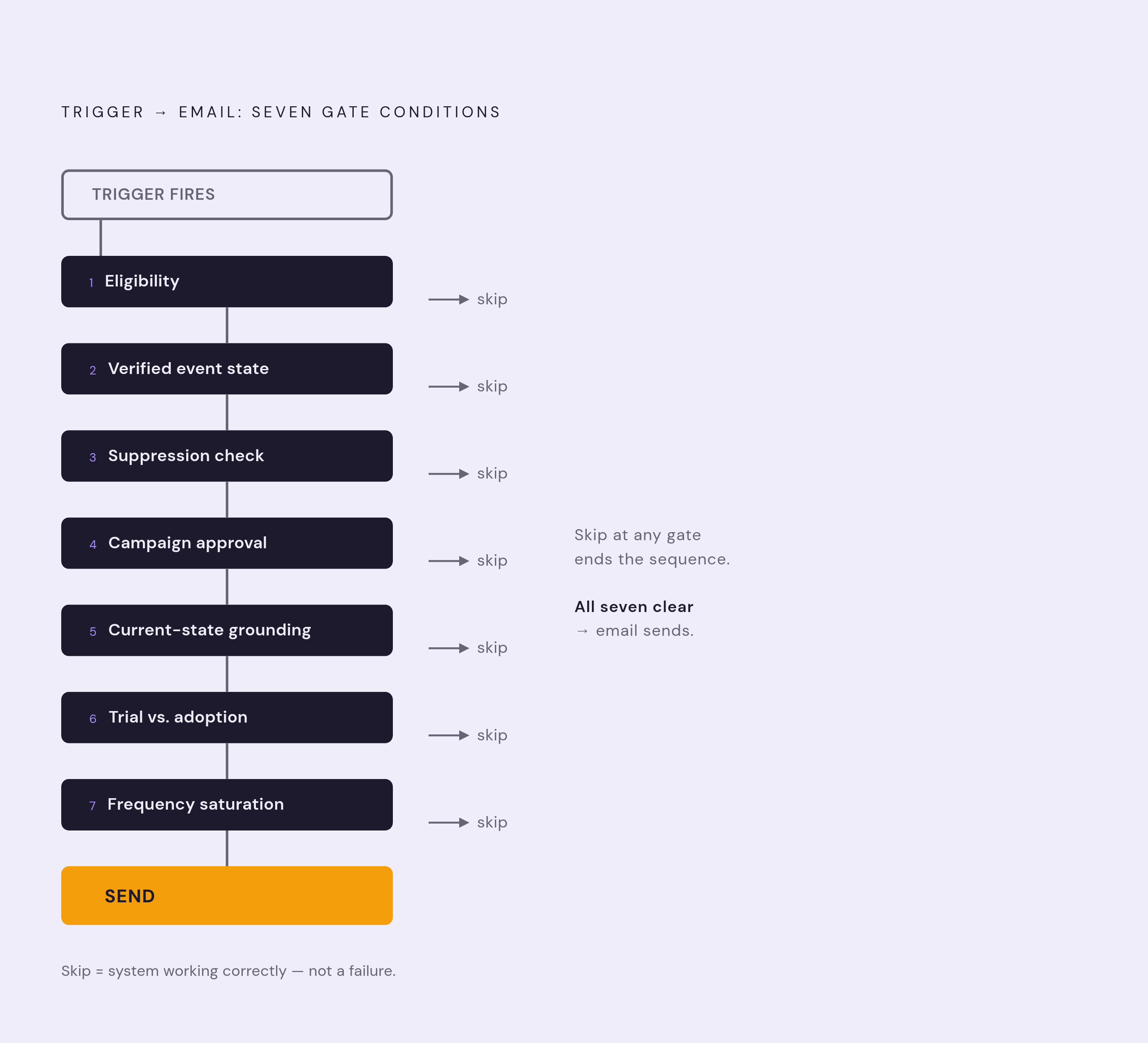
Order matters here. Eligibility filters the population first. Verified event state narrows it further. Suppression by subsequent behavior removes anyone whose problem already resolved itself. Campaign approval gates the automation before any of this runs at scale. Current-state grounding shapes what the message actually says. The trial-versus-adoption distinction sets which type of message is appropriate. Frequency caps make the final call. Each step can end in "skip," and a skip at any point is the system working correctly, not a failure to send.
A system that sends every time it technically could send is a trigger-based broadcast wearing a behavioral label, and the seven conditions are what keep that label honest.
The payoff isn't just fewer bad emails landing in fewer inboxes, though that's real too. Running all seven conditions produces something more specific: a denominator that accurately represents who actually received a justified send. That population, and only that population, is what adoption lift can be honestly measured against. Send to people who were never eligible, or who'd already solved the problem, or who were saturated on frequency, and any lift calculated against that group is measuring noise.
Userlens's Lumi is built around this exact loop: investigate each eligible person independently, write and send a grounded, personal message only when the evidence justifies it, skip when the evidence is weak, then go back to the product data and ask the only question that actually matters, did behavior in the product change. That loop, repeated across every eligible person in a campaign, is what a send-gate architecture looks like when it's actually running.