Behavioral Trigger Architecture for Downstream Messaging Systems
Most behavioral trigger systems send messages to people who shouldn't get them.

A new user exports her first report, closes the tab, and a week later gets an email asking her to try exporting a report. She already did. The system that sent it never checked. That single failure mode explains why most behavioral trigger architecture for downstream messaging doesn't work the way teams expect it to: the trigger fires the instant a product event matches a rule, without asking whether the message is justified for this specific person at this specific moment. An event arrives, a rule matches, a message goes out. Eligibility, timing, and account context get skipped entirely, so messages land on people who are on the wrong plan, in the wrong role, who already finished the action, or whose account situation makes the whole trigger irrelevant.
Instrumentation is what breaks down here. Most teams never built the signal infrastructure needed to know who is actually eligible for a given feature, so triggers get built against the full active-user base when only a much smaller eligible subset should qualify. That shortcut produces a measurement trap: opens and clicks get counted against the full user base rather than the eligible cohort, which makes adoption look weak and makes the trigger logic look like it's working when it isn't. The gap between what should be happening in an account and what is actually happening there is the real signal worth catching. Detecting that an event occurred, without knowing whether that event means anything for this particular person, is noise dressed up as data.
What a layered trigger architecture consists of
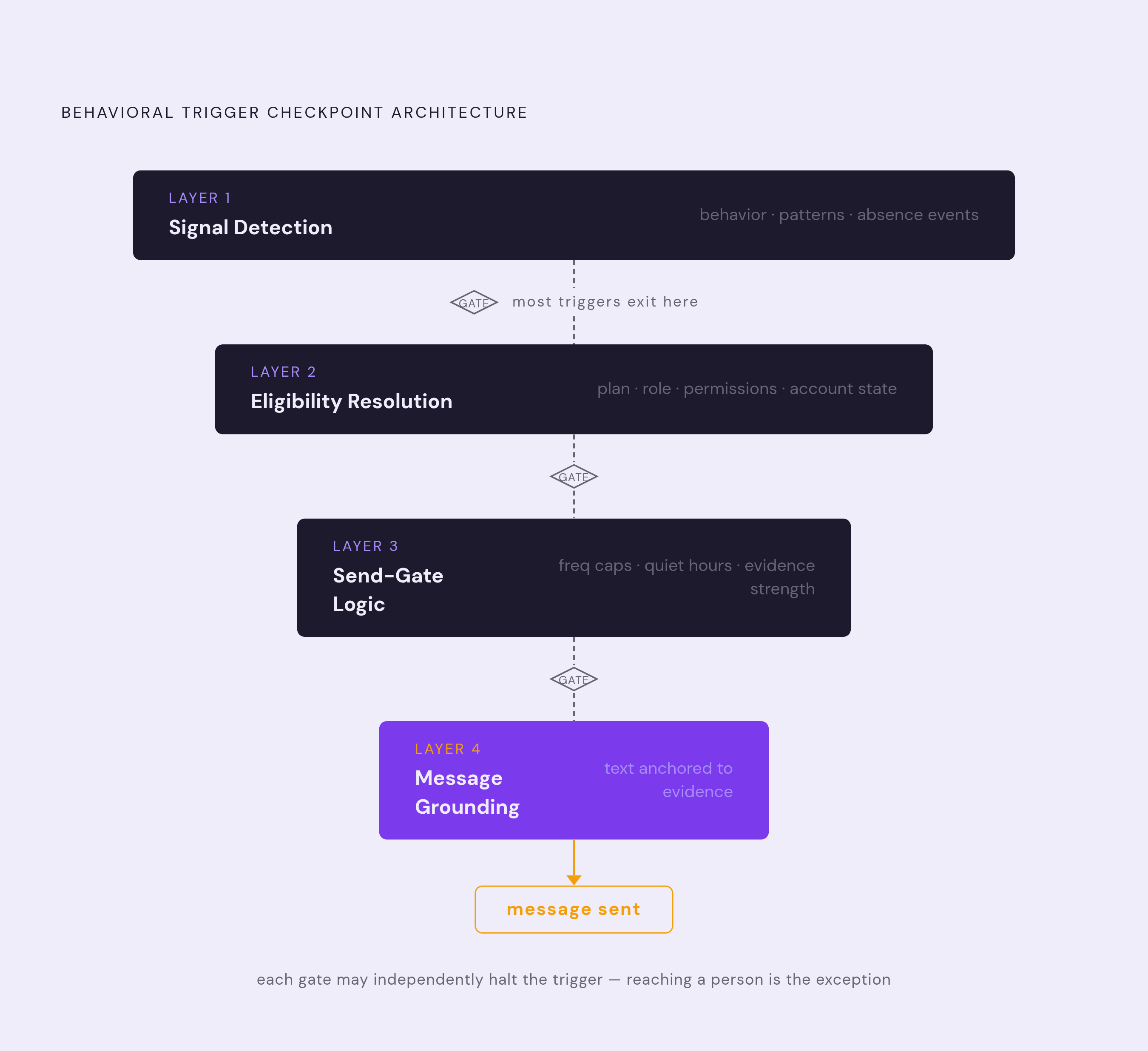
A trigger system built to avoid that failure needs four distinct layers, each one functioning as a checkpoint. Signal detection comes first: raw product behavior captured as events, whether that's an action taken, a milestone reached, or an expected action that didn't happen inside a defined time window. Eligibility resolution comes second, asking whether the current database state, meaning plan, role, permissions, configuration, makes this event meaningful for this specific person. Send-gate logic comes third: even when a signal is real and the person is eligible, conditions like frequency caps, quiet hours, never-contact flags, recency of prior contact, and strength of evidence all still have to clear before a message goes out at this moment. Message grounding comes fourth, where the actual text sent downstream gets written against the specific evidence that justified the trigger in the first place, not against a generic template with a first name dropped in.
The order matters because each layer can independently stop the trigger cold. Passing signal detection doesn't guarantee a message gets sent. It only earns the candidate a shot at eligibility resolution, and from there, a shot at the send gate, and only then at grounded messaging. That's the structural difference between simple workflow automation, where a rule fires the moment a condition matches, and an architecture that evaluates context at every stage before acting. The sections that follow take each layer in turn.
Signal detection: distinguishing a behavioral event from a trigger-worthy signal
A product event only becomes a trigger-worthy signal once it's read against what the user has and hasn't done around it. A single action, taken in isolation, is often ambiguous. A pattern is not. Someone who opens a dashboard once has tried a feature. Someone who exports a report, comes back, and exports another one has adopted it, and that distinction between trial and adoption is what separates a real signal from a false positive: only repeated, integrated use indicates something durable is happening in the account.
Absence is often the more valuable signal of the two, especially in B2B SaaS activation, where failing to take a step frequently predicts churn better than any single completed action does. A sequence event, where a user reaches step N but never gets to step N+1, points to a specific sticking point rather than general disengagement, which changes what kind of message, if any, makes sense to send. Detecting absence requires infrastructure that most event-stream pipelines don't have by default: a detection layer that runs on a schedule or a timer, checking for things that didn't happen.
Time windows are part of the signal itself, not a tunable setting bolted on afterward. "Trial activated, no core action in 48 hours" and "trial activated, no core action in 7 days" are two different signals describing two different situations, and they call for two different responses. Collapsing them into one generic "inactive user" rule throws away the information that makes the signal useful.
Eligibility resolution: reading database state before deciding a signal is actionable
A signal can be completely real at the product level and still mean nothing for the person it just fired on. The only way to find out is to check that signal against current database state the moment it fires, not against a cached profile from last week's sync. Feature adoption rate, done correctly, divides the number of users who completed an adoption event by the number of users who were actually eligible for it: the right plan, the right role, access to the feature. Using all active users as the denominator instead inflates the pool and makes a trigger system look effective at reaching people for whom the trigger was never relevant to begin with.
Several pieces of database state have to resolve correctly before a signal can advance. Plan and entitlements establish whether this person's plan includes the feature the signal concerns. Role and permissions establish whether this person is in a position to act, since an admin-only feature shouldn't generate nudges aimed at viewers who can't touch it. Configuration state establishes whether the account has completed whatever setup the feature depends on, since a trigger about an integration feature is premature if the integration itself hasn't been connected yet. And in B2B accounts specifically, individual behavior has to be checked against account-level behavior: a person who hasn't adopted a feature may belong to an account where a colleague already has, so the account isn't actually at risk, and a nudge aimed at that individual may be redundant or simply premature. None of this works off stale data. A person who upgraded plans an hour ago shouldn't get a message premised on the plan they left behind.
Connecting backend account data (accounts, people, roles, plans, configuration) with product analytics (behavior over time) is what makes this layer function at all, since neither source alone carries enough information to resolve eligibility correctly. Tools like Userlens treat this gap as the foundation of the whole system: they read both product behavior and current database state together, then decide whether a message is actually justified for a specific person at a specific moment, rather than firing automatically the moment an event matches a rule. Warehouse-native approaches, which derive trigger conditions from direct database state rather than from a streamed behavioral profile alone, carry a structural advantage here, since the eligibility query runs against the current record instead of a profile that may already be out of date. Eligibility resolution requires querying live account state, meaning plan tier, role, permissions, feature entitlements, configuration flags, at send time rather than baking assumptions into static rule logic, and an adoption agent like Userlens enforces that by resolving eligibility independently for each candidate before deciding whether to send. The objection that this adds latency and complexity misses the actual cost at stake: a trigger fired at the wrong person isn't a fast trigger, it's a wrong one, and wrong triggers sent at scale erode trust with exactly the user population a company can least afford to lose.
Send-gate logic: the conditions that govern whether an eligible trigger becomes a message
Clearing eligibility doesn't mean a message should go out right now. A separate set of send-time conditions has to evaluate independently before anything leaves the system, and these conditions belong at the gate, not buried inside the trigger rule or the message template where no one can audit them later. Frequency caps need to check whether this person received any message, from any campaign, within a defined recent window, since a gate that only checks the current campaign will let five different systems each send their own message on the same day. Quiet hours need to resolve the person's local time zone at the moment of send, not at the moment the campaign was configured weeks earlier. Never-contact flags need to be checked live: has this person or account been marked never-contact, opted out, or flagged by a sales or CSM team as being in an active conversation? A never-contact flag sitting untouched in a CRM record is not an enforced flag if nothing queries it at send time.
The most counterintuitive condition at this layer is evidence strength. Most trigger systems default to sending and require someone to write an explicit opt-out rule to stop a message. A better-built gate defaults the other way: skip when the evidence is weak, and require evidence strong enough to justify contact before a message goes out. That's a gate condition, not something left to a prompt instruction buried in a message template. Downstream message availability belongs here too, since firing the gate without a grounded message ready to send just produces a generic fallback, and a generic fallback can do more damage than staying silent would have.
None of these conditions can be set once at campaign configuration and left alone. A quiet-hours setting configured at setup goes stale the moment the trigger actually fires weeks later. A never-contact flag added after a campaign launched gets missed entirely when the gate runs only at configuration time, before the flag existed. Being part of an eligible audience doesn't automatically justify a message. That judgment happens at the gate, person by person, not at the segment level. The gate also handles channel routing, resolving whether email, in-app, or SMS fits a person's context at the moment of send. For B2B SMS specifically, compliance requirements, including TCPA in the US and GDPR in Europe, have to be handled at the platform level: the send gate has to carry compliance state itself rather than assume someone upstream already handled it. Without that separation, a person can receive multiple messages in one day from systems that never share a send-time gate, degrading the experience even when every individual trigger was configured correctly on its own.
Message grounding: writing downstream messages against the evidence that justified the trigger
A message that doesn't reference the specific evidence that justified sending it is a broadcast that happened to go out at a moment someone labeled "triggered. Grounding means the message names the actual behavior or account condition that caused it to fire, not a generic description of a feature and not a first-name merge field standing in for personalization. "Hi [Name], did you know you can export reports in [Product]?" is true for every eligible user and relevant to none of them specifically, which is exactly the kind of message grounding is meant to replace.
A grounded message points the recipient toward a specific next step tied to something they actually did or didn't do. A message that instead recites a list of recent account activity without pointing anywhere useful reads as surveillance and erodes trust. The useful version is prescriptive: it hands the person the next action to take, grounded in their own evidence. The unhelpful version is only descriptive, restating what the analytics already show without giving the person anywhere to go. In a well-designed system, a human approves the campaign's goal, audience guidance, and limits once, and within that approved frame, each individual message gets written against that person's own evidence. That structure is what makes personalization possible across thousands of people without requiring someone to sign off on every single message by hand.
Whether a grounded message actually worked comes down to one question: did behavior in the product change for the people who received it, measured against the eligible cohort, not whether they opened the email. Observed adoption after a message isn't proof of a causal lift, but it's a far more honest directional measure than a click rate, which only tells you someone's thumb moved. That measurement also closes the loop back to signal detection: if adoption among triggered users doesn't differ meaningfully from the eligible-but-not-triggered cohort, something in the trigger logic or the message grounding needs a second look. Because each layer stays distinct, the whole architecture stays auditable layer by layer.
Measuring trigger architecture performance against eligible cohorts, not total users
Architecture and measurement have to use the same eligibility logic, or the numbers will mislead in the same direction every time: tracking outcomes against the full user base instead of the eligible cohort understates real adoption and overstates how much credit the trigger deserves. The correct denominator is users who completed the adoption event divided by users who were actually eligible, meaning on the right plan, in the right role, past the relevant prerequisite, not all active users and not simply everyone who happened to receive a message.
Trial and adoption need to be measured as separate targets, because collapsing them hides exactly the distinction that matters. Trial is a single interaction with a feature, like opening a dashboard once or clicking a button one time. Adoption is repeated use woven into a person's actual workflow, the action that delivers the feature's intended value done more than once. A trigger architecture built on signal detection, eligibility resolution, send-gate logic, and message grounding only proves itself when adoption, measured against the eligible cohort, moves. Anything measured against the total user base is measuring the wrong population and will keep rewarding the wrong system.