Triggering Personalized Outreach From Product Events Without Manual Review at Scale
Send personalized messages only when product behavior justifies it.

Behavior-triggered outreach replaces the calendar with evidence: instead of sending message three on day seven no matter what, the system watches for a specific product event, or the absence of one, and sends only when that evidence appears. The architecture that makes this work at scale is a campaign layer where a human sets the goal, audience, guidance, and limits once, and an agent investigates each person independently from there. That's the shift this piece maps out, end to end, from the signal data it runs on to the measurement that proves it worked.
How behavior-triggered outreach fixes time-based sequences
A drip sequence runs on a calendar, not on what the account is actually doing. Every user on that list gets the same message on the same day, whether they finished the setup an hour after signing up or haven't touched the product since. A 2026 guide on B2B SaaS email marketing found that 78% of B2B SaaS trial emails use calendar-based timing (day 3, day 7, day 14) regardless of what the user did inside the product.
A better-written day-three email can't tell a user who already completed the action it's nudging them toward from one who's stuck on step one. The gap is structural: a schedule has no way to read account state, so it can't distinguish a job already done from a job not started.
Behavior-triggered outreach closes that gap by firing on a product event instead of a date, or on the conspicuous absence of one. A message goes out because someone connected an integration, or because three days passed without them inviting a teammate, not because a timer ran out. If the problem is schedule-based logic, the fix is event-based logic. That raises an immediate question: how do you run event-based logic across thousands of users without a human reviewing every trigger before it fires?
Scaling event-triggered outreach is an architecture problem, not a volume problem
The instinct, once outreach volume grows, is to add reviewers to the queue. Hire a few more people to read each message before it goes out, scale the review team alongside the user base. That instinct is the wrong frame. At a few hundred users, per-message human review might work. At a few thousand, it doesn't scale by adding headcount, because the constraint was never staffing. It's architectural: who, or what, makes the send-or-skip decision, on what evidence, and within what limits.
The right frame treats scaling personalized outreach as a design question, not a hiring question. A human sets the goal, the eligible audience, the guidance, and the hard limits once. That's the campaign layer. An agent then investigates each eligible person independently and decides whether the evidence is strong enough to send, or whether to skip, without looping back to a human for every individual case.
This isn't "set it and forget it" automation. Campaign-level guardrails make it safe for a system to handle "the rest.
The signal layer: current database state and behavior over time
An agent making a send-or-skip call needs two kinds of data that most growth teams keep in separate systems. The first is current database state: what plan an account sits on, what roles are configured, what features are turned on. The second is behavioral history: what events a user has actually fired, in what order, and when.
Current state tells you what an account should be doing. Behavior over time tells you what it's actually doing: whether team_member.invited or integration.connected ever fired, and if so, when. The space between those two things, what should be happening and what is happening, is the signal worth acting on. An account that should have an integration connected and doesn't is a different case than one that never had the feature available in the first place, and only a system reading both streams can tell them apart.
A few signal types matter more than others. Absence signals, someone who completed step A but never reached step B inside the expected window, are often the strongest trigger of all, because they point to a specific, nameable gap. And none of this should stay at the individual level only: a single active user inside a five-seat account is a fundamentally different situation than five active users in that same account, and an agent working off user-level data alone will miss that distinction.
Leading B2B teams in 2026 already anchor strategy on in-product signals like feature adoption and time to value. The appetite for behavioral data is established. What's missing is connecting it to current account state in one place a system can actually query. The practical relief here is that most teams don't need to re-instrument anything to start. Userlens, for instance, bridges product analytics with backend database state to surface where the two diverge, without asking a team to stand up new tracking infrastructure or pull in a data team to do it.
Translating human judgment into durable agent guardrails
Approving a campaign isn't one checkbox. It encodes four distinct judgments that together define the space an agent can act in safely, without a person reviewing every message it sends.
The goal names the specific behavior change that counts as success: a given activation event firing, a particular feature getting used for the first time, a team member invited. The audience defines who's eligible, using a combination of database state (plan type, role, configuration) and behavioral criteria (has or hasn't fired a given event). The limits set frequency caps, quiet hours, never-contact flags, and a skip-if-unsure rule, enforced at the moment of send rather than left to the agent to interpret on its own.
A concrete campaign makes the four pieces easier to see together. Picture a campaign targeting users who finished signup but haven't connected an integration after a short delay. The goal is integration.connected firing for the first time. The audience is anyone who signed up more than, say, three days ago and has no integration event on record. The limit caps outreach at one message per user per week, so the same person doesn't get nudged daily while they're still deciding.
The limits make autonomous sending defensible. An agent that skips when the evidence is thin is more trustworthy than one tuned to hit a send quota. Inside those four approved parameters, the agent still has to investigate each eligible person on their own. An eligible listing is evaluated person by person, against whatever evidence exists for that account.
Independent per-person investigation inside an approved campaign
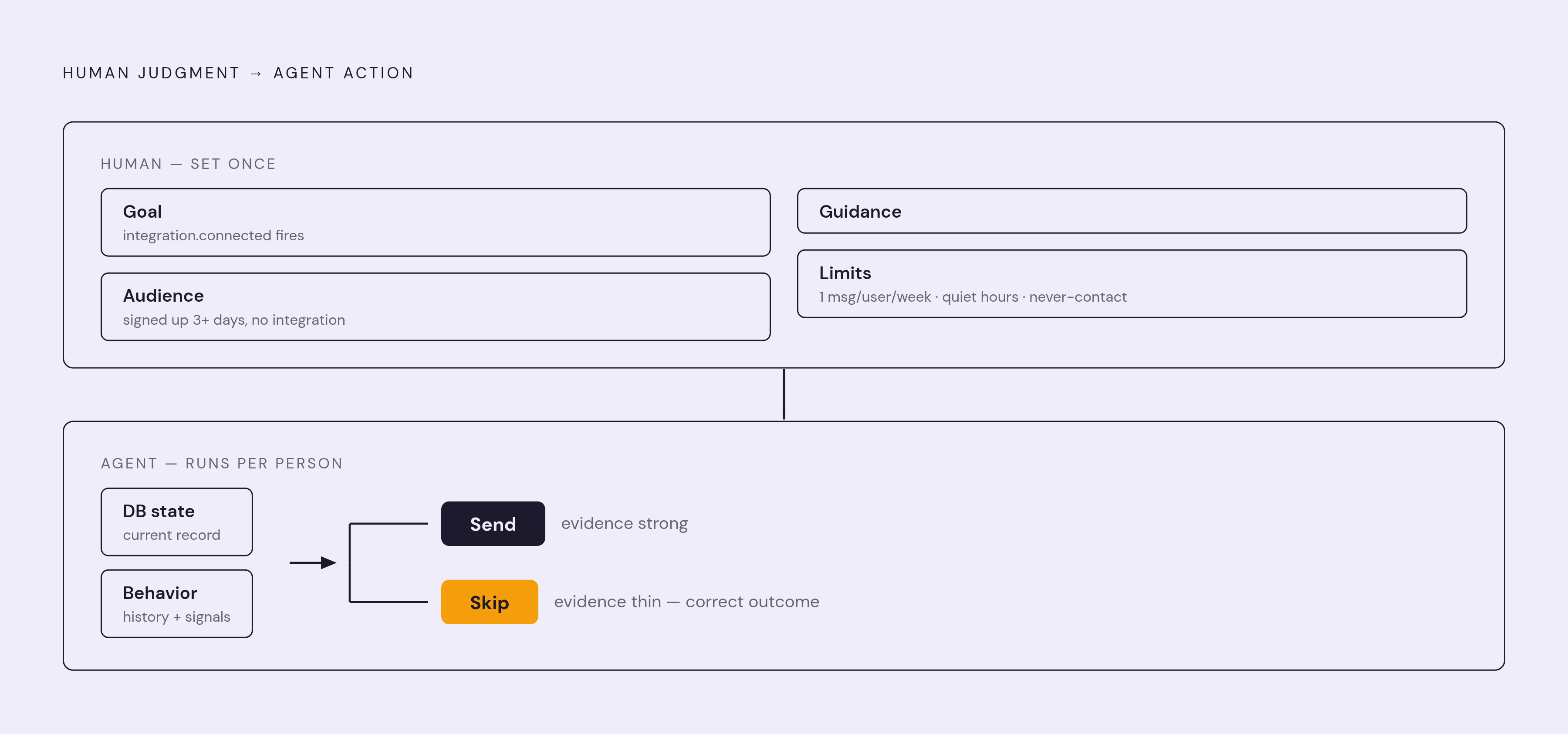
Qualifying for a campaign and receiving a message aren't the same event. An agent working inside approved guardrails still runs a per-person inquiry before it acts: it reads current state, checks behavioral history, and decides whether what it finds is strong enough to justify a send right now. A grounded message names something specific the user did or didn't do, tied to an event they actually fired or a threshold they actually crossed, and it proposes a next step that follows from that exact state rather than a generic call-to-action aimed at the whole segment. Just as often, the right output is no message at all: when the evidence doesn't support a send, the skip is the correct answer, not a system failing to act.
A simple state machine shows the range of judgment calls this produces. Someone who signed up but never took a first action gets an activation nudge. Someone active for several days who's never touched a particular feature gets a discovery message grounded in the usage pattern they already have. And someone late in a trial with no team activity at all gets something more direct: an "are you stuck?" message with a link to book time, because that pattern of evidence warrants a more pointed response than a feature tip.
A fair objection here is that this just sounds like branching logic with extra steps. Branching logic produces the same message for everyone who lands in a given branch. The distinction matters, but it shouldn't be overstated either: what's being described is a system that separates cases by evidence and composes a response accordingly, not a system that reasons the way a person would. Userlens's own positioning draws the same line carefully elsewhere, distinguishing between observing that an account adopted something after a message and claiming the message caused it. That same discipline applies here: independent investigation means tailored evidence-reading, not a claim of human-level understanding.
Prescriptive outreach versus descriptive analytics and broadcast lifecycle tools
Customer success dashboards and health-score platforms are descriptive by design. They show what happened in aggregate, often with a clean chart, and then stop. Lifecycle marketing tools are prescriptive in intent, but they operate on segments and fixed schedules: everyone in a cohort gets the same message on the same cadence, which is a form of prescription that ignores where any one account actually stands.
An adoption agent working from current database state plus behavioral history is prescriptive in a stronger sense. It looks at the specific condition of one account, decides what action that condition calls for, and either sends or skips based on that individual evidence, not a cohort average. Each tool hands a team something different in practice. A descriptive tool hands someone a chart and leaves the decision to them. A prescriptive agent hands a customer the next concrete thing to do, grounded in what they've actually built or haven't yet gotten to.
The strongest challenge to this approach is a fair one: a prescriptive agent is only as reliable as the event taxonomy and account data behind it. A wrong recommendation sent automatically costs real money and real trust, and product-led teams in 2026 increasingly treat data quality as the real constraint on what agentic systems can be trusted to do. The architecture already described answers that challenge directly. An agent's guardrails, frequency caps, quiet hours, never-contact flags, skip-if-unsure rules, have to live at that send gate itself rather than inside a prompt the agent might interpret loosely, because that's what guarantees every person gets judgment applied within boundaries a human actually set, rather than boundaries the agent is merely asked to remember.
Measuring whether outreach changed product behavior, not whether anyone opened an email
An open or a click only shows that a message arrived. It says nothing about whether the person who got it went on to do the thing the campaign was built to produce. The number that matters is whether the target behavior happened in the product afterward.
The right way to measure this is eligible-cohort adoption: of all the accounts that actually qualified for a campaign (right plan, right configuration, right behavioral gap), what share went on to use the target feature repeatedly, not once, counted only from that eligible group. Whole-user-base activation rates mislead in a few specific ways. And they flatten people into accounts, treating a workspace of ten people where only one power user activates the same as one where everyone does.
Most teams can't actually answer whether their outreach works. 2026 benchmark data on product-led growth found that only 34% of PLG companies actively track activation as a metric, and broader benchmark research describes most product-led companies as not effectively tracking their product metrics. That means most teams running behavior-triggered campaigns have no clean way to say whether any of it moved behavior.
Even clean cohort data has a real limit. Correlation at the cohort level is evidence worth acting on, but a real causal claim needs a comparison group, and teams should measure carefully enough to know when they have one and when they don't. The send-or-skip decision, the campaign guardrails, and the behavior-change measurement form one system: the guardrails define who gets evaluated and under what limits, the agent's per-person judgment decides what happens for each of them, and the measurement layer is how anyone finds out whether the goal was actually met, which is also what sets up the next campaign. A team about to launch a behavior-triggered campaign needs four things defined before it starts: the goal event that counts as success, the eligible cohort it applies to, the measurement window it'll be judged over, and the skip criteria that keep the whole signal from getting noisy.
How Userlens implements the campaign-approved, autonomous-send architecture
Userlens's adoption agent, Lumi, is built on the same separation this piece has been laying out. A human approves a campaign, its goal, audience, guidance, and limits, once. Lumi then investigates each eligible person independently, using current database state together with behavioral history, and sends when the evidence supports it or skips when it doesn't. Userlens describes this directly in its own positioning: a human approves the campaign, and qualifying for it never guarantees a message, since Lumi can wait, skip, or decide a person doesn't need help.
What Lumi is built to report back is behavior change in the product itself, tracked at both the individual and cohort level, showing who adopted, who stalled, and where follow-up still makes sense. That's consistent with the measurement discipline described above: the output is about product behavior, not message engagement.
Userlens is one implementation of this architecture, not the only possible one. Any team considering a system like it should start with the same groundwork the architecture requires everywhere: define the campaign goal, the eligible cohort, and the skip criteria before anything else. The system only works if those three inputs are honest.