Frequency Caps and Quiet Hours in Behavioral Trigger Systems
Behavioral trigger systems need gates that separate relevance from permission.

Behavior based SaaS onboarding emails need more than a relevant trigger and a personalized message. Product behavior should show who may need help, while a separate send gate decides whether they may be contacted. Frequency caps and quiet hours belong in that gate because individually useful messages can become a pileup when several events fire together.
Why behavioral trigger systems create message-pileup risks that calendar campaigns never face
A user gets five messages in one week, each of which makes sense on its own, and switches off the channel. They completed onboarding step one, which triggered message A. They stalled on step two, which triggered message B. Then they opened the help docs, which triggered message C, all within hours. Each message has a reason, but their combined effect is overwhelming.
The problem starts with how the system schedules contact. A time-based drip has gaps baked into its schedule, while an event-driven system has no gap unless something explicitly enforces one. An active user can qualify for several campaigns in a single day. If that person revokes push permission, reaching them again may require them to manually re-enable notifications in device Settings. The damage is therefore more than a moment of annoyance.
Adoption agents that write a separate message for each person face this risk acutely. Userlens describes its adoption agent Lumi as reading what each user has done and writing a message that fits. That kind of local reasoning can make a candidate message relevant, but relevance does not establish permission to send it. Without a gate that checks recent contact, several independent evaluations can each justify another interruption.
What notification priority actually is, and why a single integer field cannot encode it
The obvious response to competing messages is to rank them, but a single priority number hides four different decisions. Queue priority determines the order of processing inside the notification service. Channel-level priority sets how hard the destination platform pushes the alert into view. User-experience priority sets the alert to interrupt the person or arrive silently. Compliance priority applies quiet hours, frequency caps, and opt-outs or grants exemptions.
A number used to advance a message in a queue does not explain whether it should interrupt someone. It also cannot distinguish urgency from importance, since a system-status alert may be urgent but relevant only to a subset of admins. Above all, a high-priority promotional message must still follow quiet hours and caps. Faster processing is not an exemption from contact rules.
The human failure is just as important as the technical one. Product teams are tempted to mark their messages Critical because they believe their work matters. But importance to the sender is the wrong test for permission to interrupt the recipient. The fix is a category that determines processing, presentation, and gate behavior together.
The three-tier classification that maps message type to send-gate behavior
The three tiers turn that category into a concrete delivery rule. Critical / System covers messages essential to the product working, including OTP, password reset, payment-failed-action-required, and incident alert. In this framework, those messages bypass quiet hours, are exempt from frequency caps, and cannot be unsubscribed from.
Standard / Transactional covers expected responses to actions or state changes, including order shipped, comment reply, calendar reminder, and file shared. These messages respect quiet hours, with narrow critical exceptions, and remain subject to per-category frequency caps. Promotional / Marketing covers engagement, growth, and re-activation, including feature announcements, win-back nudges, and behavioral adoption campaigns. That tier strictly respects quiet hours and caps, and the user can opt out. A helpful onboarding nudge does not become transactional simply because product behavior triggered it.
The assignment test is whether failure to receive the notification would leave the person worse off in a way they would complain about. Critical means always yes, Standard means sometimes yes, and Promotional means rarely yes. Every product update wrongly placed in Critical uses up patience the person needs for a legitimate alert.
Once assigned, the tier becomes the single source of truth for channel headers, flags, and frequency logic. For prescriptive adoption agents, including Userlens’s Lumi, this distinction matters because personalized guidance produces many individual candidates. Approving a campaign and allowing a message to reach each person are separate decisions, even when every candidate serves the same approved goal.
How quiet hours and frequency caps interact at the send gate, including the edge case that catches teams off guard
Quiet hours control when a message can arrive, while frequency caps control how much contact a person can receive. If the person has already hit the daily cap and a message arrives during quiet hours, the message is dropped. The cap takes priority, so quiet hours do not create a route around it. If capacity remains, the message can be held until the next allowed window in the person’s local time.
The trap is treating an overnight hold as permission to deliver tomorrow. Suppose a user is at their daily limit at 10 p.m., but the system defers the message before checking the cap. The daily count resets, and the held message fires at 9 a.m. The system has preserved a message that should have been dropped and allowed timing alone to bypass the original decision.
A message that fails the cap should be dropped even if it arrived during quiet hours. A legitimately deferred message consumes capacity in the period when it is delivered. A rolling cap window is another way to prevent a calendar-day reset from allowing a held message to bypass the cap. Either way, a hold is not a reservation that overrides later checks.
Suppression adds a separate test when the allowed window arrives. The person may already have completed the target action, the offer may have expired, or the account state may have changed. Classification and timing can both be correct while the message itself has become wrong.
Treating each person's contact history as a first-class input, not an afterthought
A frequency cap cannot work from an incomplete count. Multiple campaigns, agents, and channels can all contribute to the same person’s recent contact history. A snapshot taken when a campaign was created will miss what happened afterward. The gate therefore needs a live query at the moment it evaluates a send.
That evaluation must bring several inputs together. It needs the messages sent across active campaigns in the current cap window and the tier of each pending message. It also needs current category preferences, opt-outs, and local time relative to quiet hours. Finally, it needs to know whether the triggering event still justifies contact. None of these inputs can substitute for the others.
Product state helps an agent decide what guidance might help, while contact history helps the gate decide whether another message is allowed. A state such as “opened two pushes this week, do not send more” is a contact-history fact. An agent has no inherent view of cross-campaign history merely because it understands one person’s product behavior. That information must be supplied explicitly and evaluated by the delivery controls.
Why send-gate controls belong in the system, not in the agent's instructions
A prompt can ask an agent to be restrained, but it cannot serve as the authority that prevents a send. The agent may decide that a particular message is important enough to override general guidance. A limit buried in a long context also competes with other instructions. Even an agent that pays full attention cannot check recent contact if it has no access to that history. A rule about live system state requires more than words describing the rule.
The correct separation is that the agent generates candidates and the gate decides whether they may leave the system. Caps, quiet hours, tier rules, and suppression checks are enforced in code at evaluation time, independently of the candidate’s wording. Financial transaction systems use the same principle. The rules engine that validates a transaction is separate from the form that generated the request. A persuasive request does not get to approve itself.
Campaign approval is another separate layer. A human approves the goal, audience, guidance, and limits once, after which the agent can investigate each person and draft a message within that scope. The send gate still enforces the limits for every delivery. When evaluating Userlens or another adoption agent, that separation is the architectural criterion that matters, rather than whether its prompt contains reassuring language about restraint. Approval authorizes a campaign within its approved limits.
What a well-designed send gate looks like end to end, from event to delivery decision
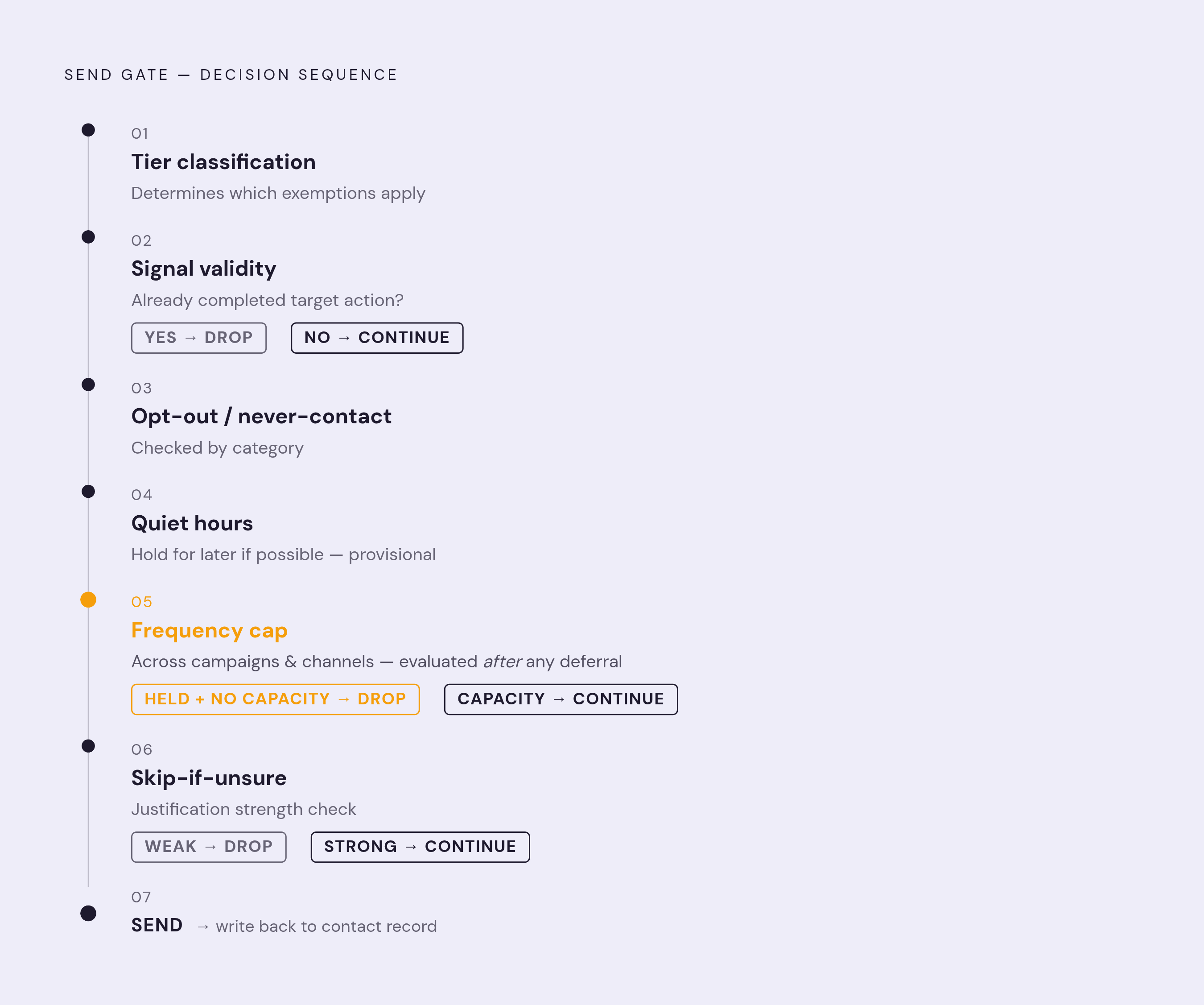
The sequence starts with tier classification, which determines which later checks apply and which exemptions exist. The second check tests whether the triggering signal is still valid. If the person has already completed the target action, the candidate stops there. The third check applies opt-out and never-contact flags for the message category, subject to the tier’s rules. These checks establish whether there is still a reason and permission to proceed.
The fourth check looks at local quiet hours and whether the candidate may be held for later. That decision remains provisional until the fifth check evaluates the frequency cap across campaigns and channels. Under the daily-cap rule, a candidate arriving during quiet hours with no capacity left is dropped. A candidate legitimately held for a later window must face the applicable delivery-period cap. The order of the checks must not turn deferral into an exemption.
The sixth check applies skip-if-unsure logic. Unlike a hard opt-out, this is a policy for withholding contact when the evidence behind the message is weak. It gives the system a way to decline an otherwise permitted send because its justification is not strong enough. Permission and confidence answer different questions, so both deserve a place in the decision.
Only after those checks does delivery occur. The seventh step sends the message and immediately updates the contact record. That write-back is a required part of enforcement. Without it, the next check counts too few recent messages and may allow another one to use capacity that has already been used.
Measuring whether the gate is working, without confusing delivery suppression with adoption failure
A team that optimizes for messages sent will steadily treat its own safeguards as obstacles. The useful outcome is adoption in the eligible cohort. For campaign measurement, that means distinguishing people eligible to receive the message from those withheld by a cap, quiet-hours deferral, or opt-out. The audience defined at campaign creation is not automatically the delivery denominator. Gate decisions explain the difference.
That means logging why a send stopped as well as which messages were delivered. Comparing adoption among suppressed and messaged users can then help assess whether restraint is appropriate. Similar adoption rates are consistent with suppression withholding messages from people who would adopt anyway. If adoption is significantly lower among users whose messages were suppressed, the gate may be cutting off useful guidance. Neither comparison on its own proves that the message caused adoption, because behavior seen after a message shows correlation without proving causal lift.
For team products, calibration also needs an account-level view. Track the share of eligible accounts that reach the adoption threshold so several people in one workspace do not appear as independent signals. Then read adoption rates together with suppression and opt-out rates. If suppression rises while adoption stays flat, the cap may be too tight, while more opt-outs when many messages are being sent suggest it may be too loose. The goal is not to maximize delivery, but to keep useful guidance possible without exhausting the channel that carries it.