Behavioral Personas Derived From Cluster Analysis of Product Events
Behavioral patterns predict outcomes better than job titles or company size.
A user's job title tells you nothing about whether they'll hit an activation milestone, adopt a key feature, or go quiet in week three. Those are the behavioral signals that actually separate accounts that expand from accounts that churn, and demographic data simply doesn't carry them.
Firmographic segmentation, built from company size, industry, and role, can tell a sales team which accounts look like good targets. It can't tell them which of those accounts will actually succeed, or explain why two companies with nearly identical profiles end up on opposite paths, one renewing at a higher tier and one going silent. Pipedrive's engineering team put this directly in their own work on the subject: traditional personas are broad and soft, because the link between a demographic label and actual product use is indirect at best. Behavioral personas, built instead from what customers do inside the product, close that gap.
Ignoring this cost is visible in how teams communicate. A firmographic segment gets one message, sent to everyone in it, whether those users are power users, stalled at setup, or never activated. A new sequence of emails reaches a user who already finished onboarding three weeks ago right alongside a user who never completed step one. Grouping people by observed behavior instead of by who they are asks a different question: not who these people are, but what they actually do, and which of those patterns predict good or bad outcomes.
What behavioral personas are
A behavioral persona groups users by the pattern of actions they take inside a product, not by their title, company size, or what they said they wanted in a survey. Where a traditional persona asks who someone is, a behavioral persona asks what someone has actually done.
Traditional personas come from qualitative research: interviews, surveys, market studies, distilled into semi-fictional profiles organized around demographics and stated motivations. They're useful for understanding values and attitudes in the abstract. They're weak at predicting what a specific user will do next inside a specific product. Behavioral personas flip the source material. They come from product usage data: event streams, feature interactions, session patterns, organized around observed action instead of stated intent. Pipedrive's engineering team draws the line directly, describing behavioral personas as personas that describe customers "based on what they do: their interactions with your product rather than demographics or market data."
That distinction matters because behavioral personas are empirical. They come from data the product already generates, reflecting a workshop's best guess about who might be using it. You build a traditional persona once, print it, and pin it to a wall until the next rebrand. A behavioral persona updates as the underlying usage data changes. It stays accurate to how people are actually behaving right now, not how a research project characterized them a year ago.
Extracting behavioral personas from product event data with cluster analysis
Cluster analysis finds the natural groupings inside product usage data. It doesn't start from a human assumption about what the segments should look like. It starts from the events themselves and lets the structure emerge.
The raw material is every action a product records: which features get used, which workflows get completed, how users navigate, who invites teammates, who connects an integration. Stitched together over time, this becomes a behavioral fingerprint, unique to each user, built entirely from what they did rather than who they claimed to be.
The choice of algorithm shapes what comes out the other end. Pipedrive's team chose non-negative matrix factorization, known as NMF, for their clustering work. NMF suits usage data well because it produces additive, interpretable components: a user's behavior gets described as a weighted mix of underlying usage patterns, rather than forced into a single hard bucket. That distinction carries real weight. Hard clustering methods like k-means assign each user to exactly one group, which sounds clean but rarely matches reality. Most users show traits from more than one behavioral pattern at once, acting like a power user in one part of the product and a stalled beginner in another. NMF's soft membership captures that overlap instead of erasing it with a forced label.
Event sequences within each group resemble each other more than they resemble sequences in other groups, and the groups themselves emerge from the data without anyone specifying in advance what they ought to be. Those groups, the behavioral signatures that recur across the user base, become the working definition of each persona.
The segments that appear
The groups that fall out of this kind of analysis aren't arbitrary. They map to fundamentally different relationships with the product, and those relationships carry predictive weight well before an outcome like renewal or churn actually happens.
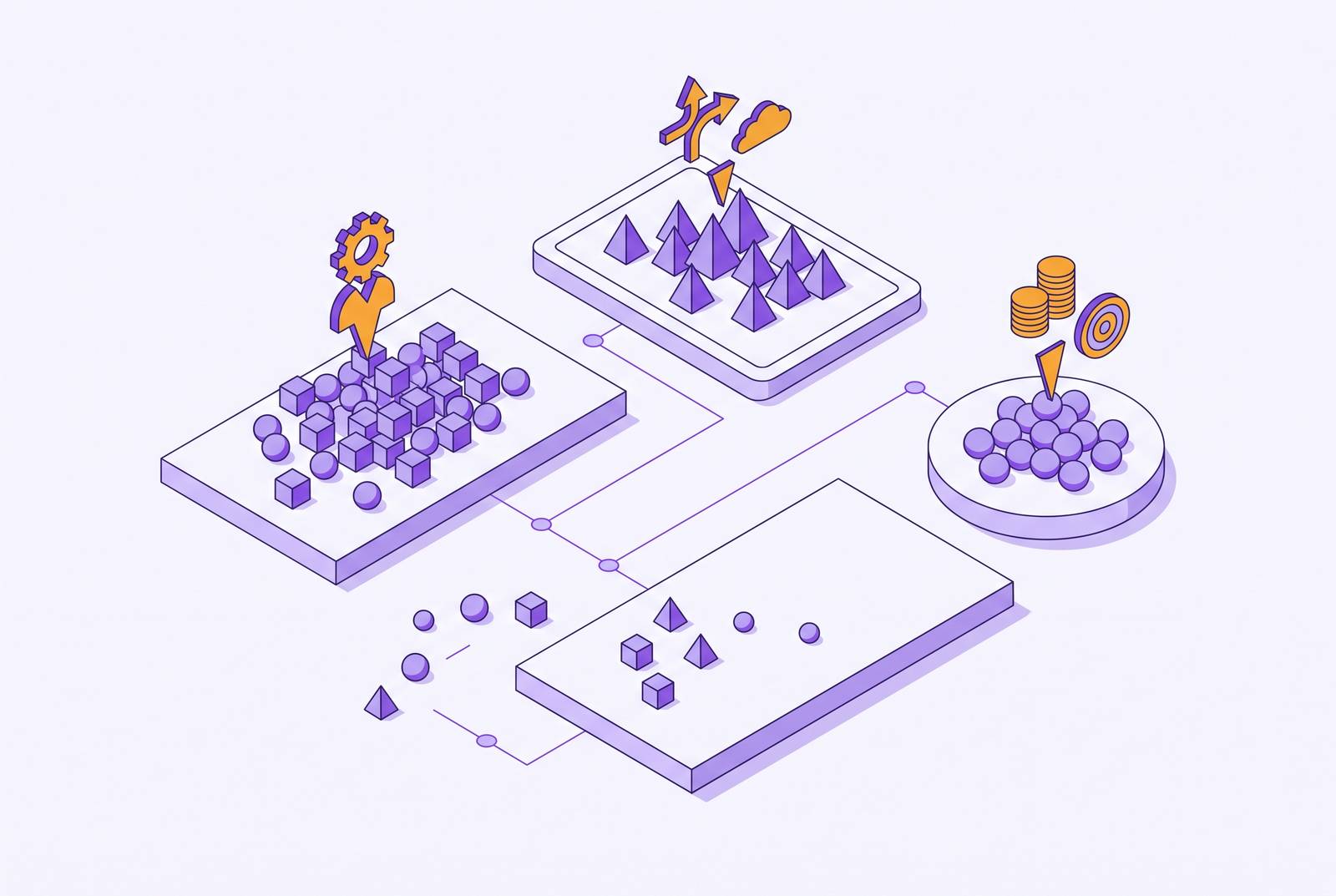
A few shapes tend to recur. Users who reach a first moment of real value and keep coming back form a group built around habit, and they behave differently from users who finish setup steps but never actually touch the core workflow the product was built for. Users who invite teammates or connect integrations form another group entirely, one that signals the product is taking root across an organization rather than staying confined to a single enthusiastic individual. That's a meaningfully different position than a solo power user who's personally engaged but represents a thin foothold at the account level. A third shape runs in the opposite direction: users who show a burst of early activity and then go quiet. That stagnation pattern appears in the event data weeks before it turns into a churn number on a dashboard.
Pipedrive's clustering work used product usage data for exactly this purpose: finding these behavioral patterns and turning them into personas grounded in signal, not demographic guesswork. What makes the predictive power real is sequence and combination, not any single action in isolation. It's rarely one event that separates an account headed for expansion from one headed for churn. It's a particular combination of actions, in a particular order, at a particular pace. Comparing the trajectory of accounts that expanded against the trajectory of accounts that stalled or churned is what turns a cluster from a descriptive curiosity into an early warning system, or an early green light.
The correlation-causation problem in behavioral personas
A cluster showing that users who adopt some feature retain better doesn't prove the feature causes that retention. Users who adopt it might simply be more engaged across the board, and the feature is a symptom of that engagement rather than its source.
That limitation doesn't undercut the value of behavioral personas. It sets the right expectation for how to use them. A cluster is a starting point for action; it is not a final verdict on cause and effect. It flags a pattern worth investigating and worth acting on in low-stakes situations, but it does not replace the controlled experiment needed before a team sinks real investment into building out a feature on the strength of a correlation alone.
For designing an intervention, like deciding what nudge to send a stalled user, correlation is enough to act on. Pointing a stalled user toward a behavior that correlated with success in similar users is a better bet than silence or a generic message that ignores their situation. So you use behavioral clusters to shape these interventions, then track whether behavior actually changed afterward, and you treat observed adoption and proven causal lift as two different claims. Save the formal experiment for decisions where the financial stakes justify the cost of running one.
None of this works without clean, unified event data sitting underneath it. That data layer has to exist before any clustering, any persona, or any intervention can happen. It's the foundation every other decision in this stack depends on.
Behavioral segmentation predicts conversion better than demographic personas in practice
In practice, behavioral segmentation groups prospects along three dimensions: engagement patterns, decision authority signals, and urgency indicators. These three reflect how a buyer is actually moving through a decision, rather than which category a form field says they belong to.
Engagement patterns are observable directly: how someone interacts with a feature or a piece of content, not how a sales rep guesses they feel about it. Decision authority signals come from behavior too, surfaced from what someone actually does rather than read off an org chart that may not reflect who really holds influence. Urgency indicators appear in event frequency and session patterns well before a prospect says anything explicit about their timeline.
A demographic persona can suggest that a prospect fits the target profile, but it can't predict whether that prospect is actually ready to move. Behavioral clusters predict both intent and deal velocity, and that's what decides whether an outreach message lands as timely help or as noise in an inbox.
Consider a technical evaluator who keeps returning to integration documentation. That behavior tells you what this person needs to hear: proof and implementation detail, regardless of their job title. An economic buyer's pattern looks different: it appears as time spent on ROI-focused pages and repeat visits after a demo. That pattern signals urgency far more reliably than seniority alone ever could.
How behavioral personas translate into persona-specific messaging triggers
Once a behavioral cluster is defined, its event pattern becomes a trigger condition for a specific kind of message. It's a genuinely different intervention, grounded in what a given user has and hasn't done, not a content variant slotted into a template.
The underlying principle is simple: the behavior is the trigger, not the calendar and not a persona label stapled onto a contact record. A message fires when a user's event pattern matches the signature of a cluster that calls for a specific next step.
A few examples make this concrete. A user whose pattern matches "adopted the core workflow, never connected an integration" gets a message about integration, grounded in an actual behavioral gap rather than a demographic hunch. A user whose pattern matches "early burst of activity, now quiet" gets a re-engagement message that names the specific workflow where they stopped. A user whose pattern matches "active collaborator, expanding team usage" becomes the signal for an expansion conversation, delivered by a different sender, at a different moment, than whatever outreach greeted them during activation.
That's the real contrast with broadcast marketing. A broadcast campaign fires on a schedule, or off a single isolated event. A persona-specific trigger fires on a pattern across multiple events that represents a meaningful behavioral state, a different and more precise unit of signal. The message itself still has to be useful and respectful rather than a recitation of tracked activity. The goal is to hand someone the next step that's useful to them right now, grounded in what they've done and what similar users did next, not to prove that someone's been watching their every click.
The prescriptive layer
Analytics dashboards and lifecycle marketing tools describe. A dashboard surfaces what already happened. A lifecycle sequence fires a pre-written message when a single event occurs. Either way, the team gets a chart, and the customer doesn't get a next step.
Most teams have automated the output side of customer engagement: the emails, the tasks, the health score alerts. Few have automated the input side, the judgment about whether a message should go out at all and what it should say. A health score drops, a playbook fires on schedule, and no one actually knows why the score dropped or whether that playbook fits this particular user's behavioral state.
Turning cluster-defined patterns into a working system means building a library of messages organized by behavioral trigger instead of by persona label, then running that matching process at scale, for every eligible user, independently and continuously. That execution step is what separates a prescriptive layer from a dashboard. A prescriptive system takes each user's current event pattern, matches it against the behavioral signatures cluster analysis has already defined, checks whether the evidence is strong enough to justify reaching out at all, skips the user when it isn't, and writes a message grounded in that specific person's situation rather than a template addressed to a segment.