Tracking Plan Governance Across Product and Engineering Teams
Establish ownership and naming standards to keep tracking plans trustworthy.
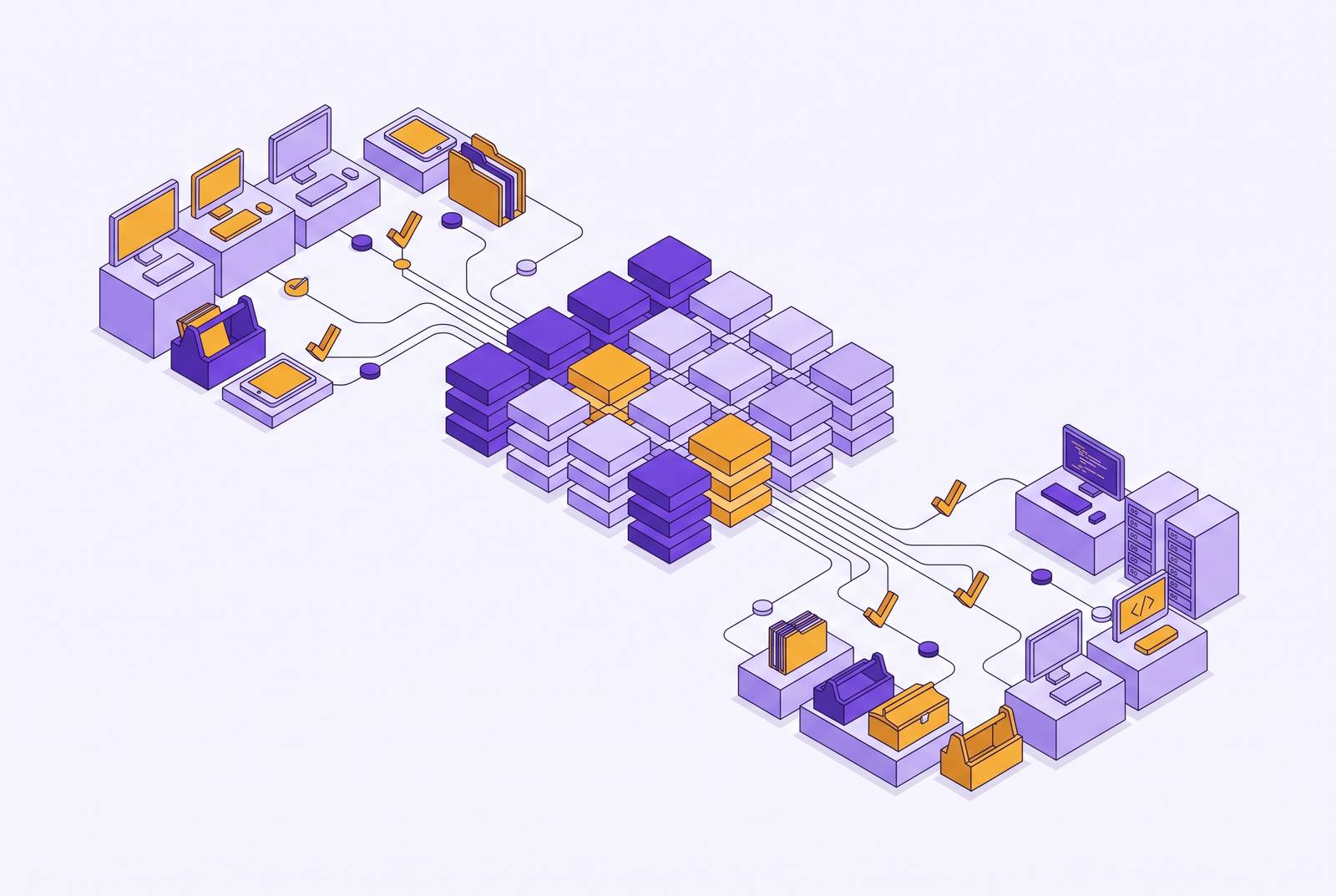
A tracking plan is a shared contract for how events get named and defined across the business. It's a schema document, and every row in it should map an event to a business question, a trigger, a payload, an owner, a PII flag, and the downstream systems that consume it. The principle of starting with the business question, not the event name, is the ordering most teams get backwards. Ask "are users reaching the activation milestone?" first. That gets you to a KPI, activation rate, and only then to an event: onboarding_step_completed with a step_name property. Working forward from whatever seems worth logging leaves schemas bloated with events nobody can justify six months later, a direction that should be avoided entirely when building in.
A governed plan carries a specific set of columns, and skipping any of them is where the drift starts. Event name and version matter, with an event_version field stamped on every payload. So does the business question the event answers, plus a plain-language description of the trigger, a property list with data types spelled out, and a named owner, one person, never a team. Add a last_verified date, a pii_flag that triggers masking before data hits the warehouse, a downstream_systems column naming every consumer explicitly, and a plan_version that gets bumped any time the schema changes.
What doesn't belong in the plan matters just as much, and founder-os.ai's framing is useful here. Vanity traffic metrics don't belong. Neither do one-off SQL dashboards nobody maintains, or "track everything" schemas built by someone afraid to leave something out. Whether the source of truth lives in a Google Sheet, a Notion doc, or a Git repo matters less than whether teams actually propose changes there before touching implementation. The format is a container. The discipline is the point.
The downstream_systems column ends up doing the heaviest lifting in the whole document. It forces someone to justify an event's existence by naming who actually consumes it. An event with nothing in that column is an orphan, and orphans are exactly what a 90-day audit is built to catch.
How ownership splits between product and engineering
Customerscore.io documents a split that holds up in practice. Product owns the business question, the "why" behind an event, and if nobody can explain why an event exists, that's a product accountability gap, full stop. Engineering owns the "how": the trigger, the payload structure, when the thing fires and what data rides along with it. Analytics enforces schema compliance and owns the last_verified date. One named person, not a team, accepts responsibility for how each event gets used downstream.
Team-level ownership is the mistake most orgs make here, and it's a more common one than most teams admit. "The analytics team owns events" sounds like accountability but functions as diffusion, because when something breaks, everyone assumes someone else caught it first. Assigning ownership to a group is functionally the same as assigning it to no one. The handoff that actually works looks like this: product proposes a name and a business question in the source-of-truth doc, engineering validates the trigger and payload before writing a line of implementation code, and analytics signs off that the schema lines up with the downstream use case it's meant to serve.
New events need a gate before they ship: a name review plus a property checklist. That's the lightest possible version of governance that still prevents the central failure founder-os.ai flags, which is schema changes with no owner behind them. Identity resolution deserves a mention too, because it's often treated as purely an engineering concern, and it isn't. Product has to specify whether the unit of analysis is the person, the account, or both, since activation funnels and retention views live or die on that distinction. Get it wrong and every downstream cohort report inherits the ambiguity.
Tracking plan ownership should sit inside the same product-and-engineering split rather than getting handed off to a separate data team with no context for either side of the product.
Naming conventions that survive team turnover
Bad naming is a structural problem. It's a governance failure with a delay on it. Inconsistent names produce duplicate events, funnels that quietly break, and queries that three different analysts resolve three different ways, and the plan becomes untrustworthy even when every event is firing exactly as intended.
The convention worth standardizing on is object_action in snake_case: onboarding_step_completed, bulk_export_initiated, feature_flag_enabled. Object first, past-tense verb second, every time. Anything looser than that, camelCase mixed with snake_case, verbs before objects in some events and after in others, is what makes a plan unreadable within a year. Name review, in practice, means checking a proposed name against the existing plan for collisions or near-duplicates before it gets added, writing out the business question in plain words, and confirming the name obviously answers it. If it doesn't, the convention is right and the name is wrong. Property names follow the same rule and get checked for type consistency across the whole plan; a property called user_id has to be a string everywhere, not a string in one event and an integer in another.
Version discipline covers what naming can't. When a property's type changes or a field gets renamed, bump event_version rather than inventing a new event name. Segment Protocols supports exactly this through context.protocols.event_version, and it's what keeps downstream systems from breaking during a schema migration.
B2B SaaS behavior happens at two levels, the individual user and the account or workspace, and the event name should make clear which one it's describing. Cohort analysis and activation measurement both depend on that distinction being unambiguous at the naming layer, not inferred later from context. Turnover is the real test of all of this: when the engineer who built a feature leaves, the name and the convention behind it need to be self-documenting enough that whoever inherits the code can find the event, understand what it does, and extend it without quietly creating a near-duplicate three months later.
The 90-day audit and how to make it happen on a schedule that already exists
House of MarTech's rule is blunt and correct: any event with a last_verified date older than 90 days should be presumed broken until someone checks it in production. Treat that as a forcing function, not a suggestion teams get to skip when things get busy. And they will try to skip it exactly when things get busy, which is precisely the moment new events are getting added fastest and drift is accelerating hardest.
Don't build a new meeting for this. That instinct is the one that kills most audit programs within two quarters. Attach the audit to the quarterly business review that's already on the calendar instead. The cadence gets inherited instead of invented, and the business context, what actually matters this quarter, is already in the room when the audit happens.
The audit itself covers four things. Every event past its 90-day last_verified window gets flagged for a production check. Events with no named owner get escalated immediately, and this is arguably the single most useful output of the whole exercise, because an ownership gap is the thing most likely to cause silent damage. Events with an empty downstream_systems column become deprecation candidates. PII flags get re-confirmed, since data classification drifts as product scope expands, and something that wasn't sensitive a year ago sometimes is now.
Failing the audit doesn't mean an event disappears overnight. It gets marked deprecated with a date attached, stays live for one more version cycle, then comes out. That gap matters, because it stops downstream systems from breaking against an event the plan has already declared dead but that something is still quietly querying.
There's a second payoff buried in the audit that's easy to miss. Events nobody queries, that map to no downstream system, and that trace back to features with near-zero usage: that's a roadmap signal, not just a data hygiene one. Governance data ends up feeding product judgment about which features are actually earning their keep.
Enforcing the schema at the technical layer so drift is caught before it reaches the warehouse
A governance document sitting in Notion describes intent. It doesn't enforce anything, and treating it as if it does is where most plans quietly fail. The gap between the two is where corrupted data slips through, and closing that gap means putting a validation layer between the source and the warehouse that catches drift before it writes bad rows, not trusting a human to notice.
Customerscore.io describes how this looks at the customer data platform level: when a property changes shape at the source, the sync engine flags it as a schema-drift error on the next run instead of quietly passing the bad data through. At that point the governance artifact and the enforcement layer are effectively the same surface, which is the goal. On the CI side, the sequence is straightforward. Propose a schema change in the source-of-truth document, update the schema and bump plan_version, then run CI validation against the new spec before anything ships to production.
This setup catches three specific failure modes. A property renamed without a version bump shows up as the old name gone missing and a new, unregistered name in its place. A type mismatch surfaces when user_id arrives as an integer but the schema says string. And a brand-new event that skipped the plan entirely arrives in the pipeline with no business question, no owner, no entry in downstream_systems, visible immediately as an outlier.
PII enforcement belongs at this same layer, not in a human review queue, because human review queues are exactly where PII slips through. A pii_flag set to true in the plan should trigger automatic masking before the event ever reaches the warehouse, tied directly to the flag rather than a step someone remembers to do. Once enforcement is in place, the tracking plan stops being a reference doc people consult after something breaks. It becomes a contract the pipeline actively checks against.
Connecting event discipline to activation and feature adoption measurement
The feature adoption funnel, Exposed, Activated, Used, Used Again, only means anything if the events behind each stage fire correctly and consistently over time. Bad event data doesn't just add noise, it actively lies. A renamed event breaks the "Used" stage and shows a cliff in the funnel that looks like a behavior change but is actually a naming change. A missing account_id property collapses person-level and account-level signals into each other, and cohort analysis by plan tier or segment stops meaning anything. An unversioned payload change makes month-over-month comparison invalid, because the trend line is quietly comparing two different schemas as if they were one.
Activation rate is the clearest downstream casualty. A Userpilot 2026 benchmark puts activation at roughly 37.5% of signups. Any team trying to move that number is stuck if the activation event itself isn't tracked consistently, because they can't tell whether a change in the metric reflects real user behavior or a schema change nobody flagged.
Eligible-cohort measurement runs into the same wall. "Users who used the feature" divided by "active users" only means something if both of those events are governed with equal rigor. A bloated or duplicated active-user event inflates the denominator and makes adoption look worse than it actually is, and nobody notices because the number still looks plausible on a dashboard.
Behavior-triggered guidance depends on the same accuracy. Sending re-engagement messaging to users still exporting records one at a time after a bulk export feature ships only works if the events distinguishing old behavior from new behavior are named correctly, owned by someone, and validated on a schedule. ProductLed's 2025 State of B2B SaaS report, covering 446 companies, found that companies with self-serve revenue scored 19% higher on data capabilities than those without. Self-serve forces the discipline, because there's no human in the loop to paper over a data gap the way a sales or CS team might.
The change-management layer: getting product and engineering to maintain the plan together
The failure pattern repeats across companies almost identically. A data crisis forces a governance push, the plan gets maintained diligently for one quarter, and then it drifts again because no ritual keeps it alive and nobody's job evaluation is tied to whether it stays current.
Turning the audit into a shared ritual instead of a data-team chore is what breaks that cycle. The audit findings at the QBR should be tied directly to business-question ownership, since that column is a product accountability in the first place. Someone with visibility into downstream dependencies should confirm which systems still reference an event before it actually gets removed. New feature tickets should carry a tracking plan update as an acceptance criterion from the start, not a follow-up task that gets deprioritized the moment the sprint gets tight.
The most durable governance lives inside the workflow a team already has, not in a separate meeting competing for calendar space. A checklist item on the feature ticket. A column on the sprint board. A CI validation step that checks the schema before anything ships to production. That's governance that survives, because it's not asking anyone to do extra work outside their normal process.
Naming one owner per event changes the incentive structure in a way that team ownership never does. When something breaks in production, a specific person gets paged, not a channel, not a team. The cost of letting an event drift becomes personal and immediate instead of abstract and shared, and that's what actually keeps a plan current over time.
The model scales without needing a central data team to hold it together. Each new squad gets its own event namespace and its own named owners, inheriting the same naming convention and the same audit cadence that's already working elsewhere in the org. The structure multiplies because it's built into squad rituals from day one, not bolted onto them later.
A tracking plan that stays trustworthy compounds in value the way few other internal documents do. Activation campaigns, adoption cohorts, re-engagement logic, expansion signals: none of it holds up if the events underneath are ungoverned. Governance is the unglamorous part of the analytics stack that decides whether anything else in that stack can be trusted.