Server-Side vs Client-Side Event Capture in SaaS Products
Client-side tracking misses blocked users; server-side alone misses browser behavior.
Choosing between server-side and client-side event capture in a SaaS product is not a matter of taste or engineering convenience. It's a data-quality decision, and getting it wrong means product and PLG teams end up steering the business on a partial, skewed slice of what users actually did. Each method fails in its own way, and those failure modes, not vendor preference, should decide where a given event gets tracked. Get the split wrong and the metrics built on top of it will be confidently, specifically wrong.
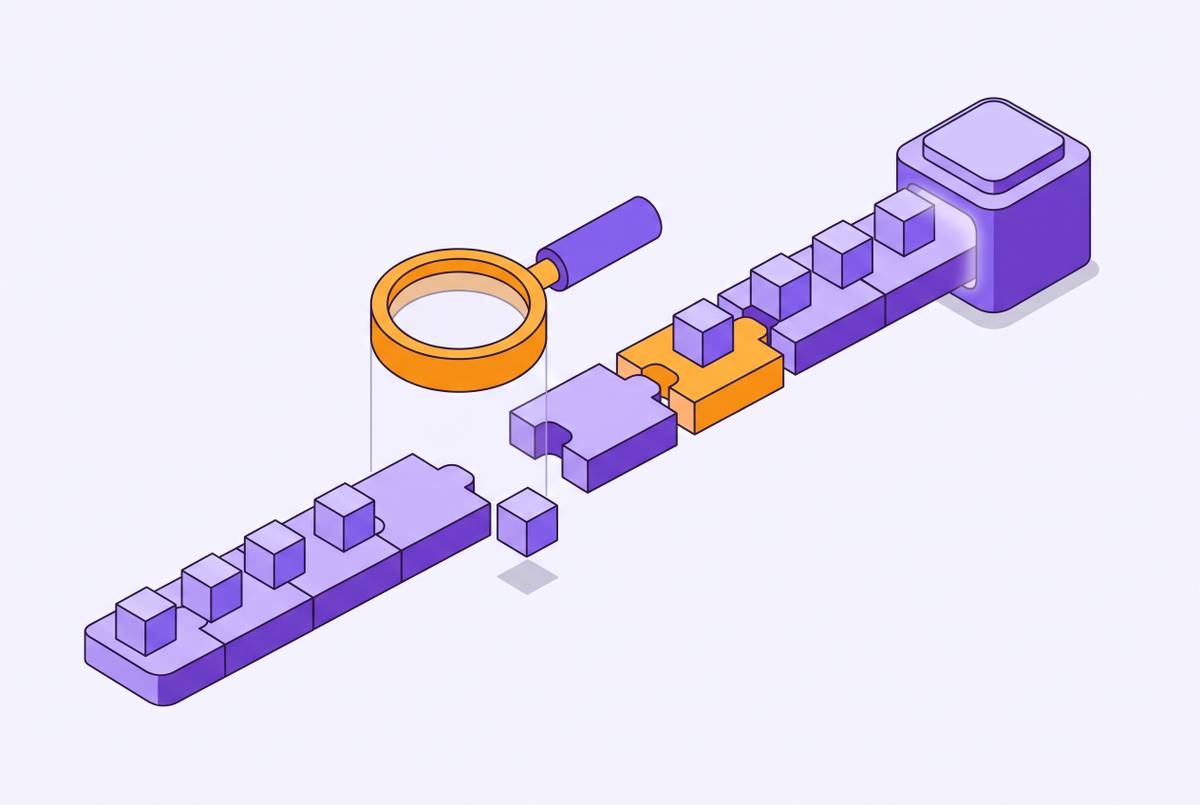
Client-side capture runs JavaScript in the user's browser the moment something happens, capturing a page view, a click, a UI interaction, session context, or referrer data. The browser does the work, which means the browser also gets a vote on whether the event survives. If it refuses to run the script, whether because of a blocker, a privacy setting, or a network filter, the event never leaves the device. It doesn't log late or log incomplete. It just never existed.
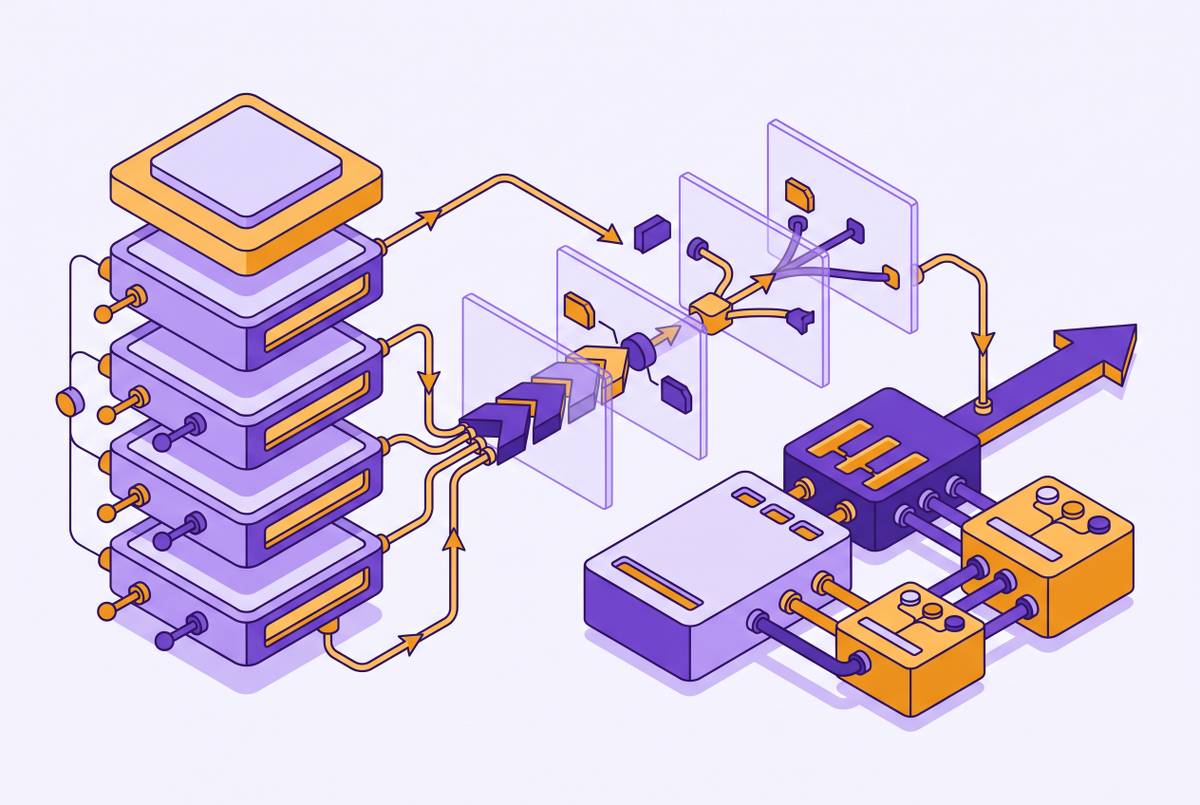
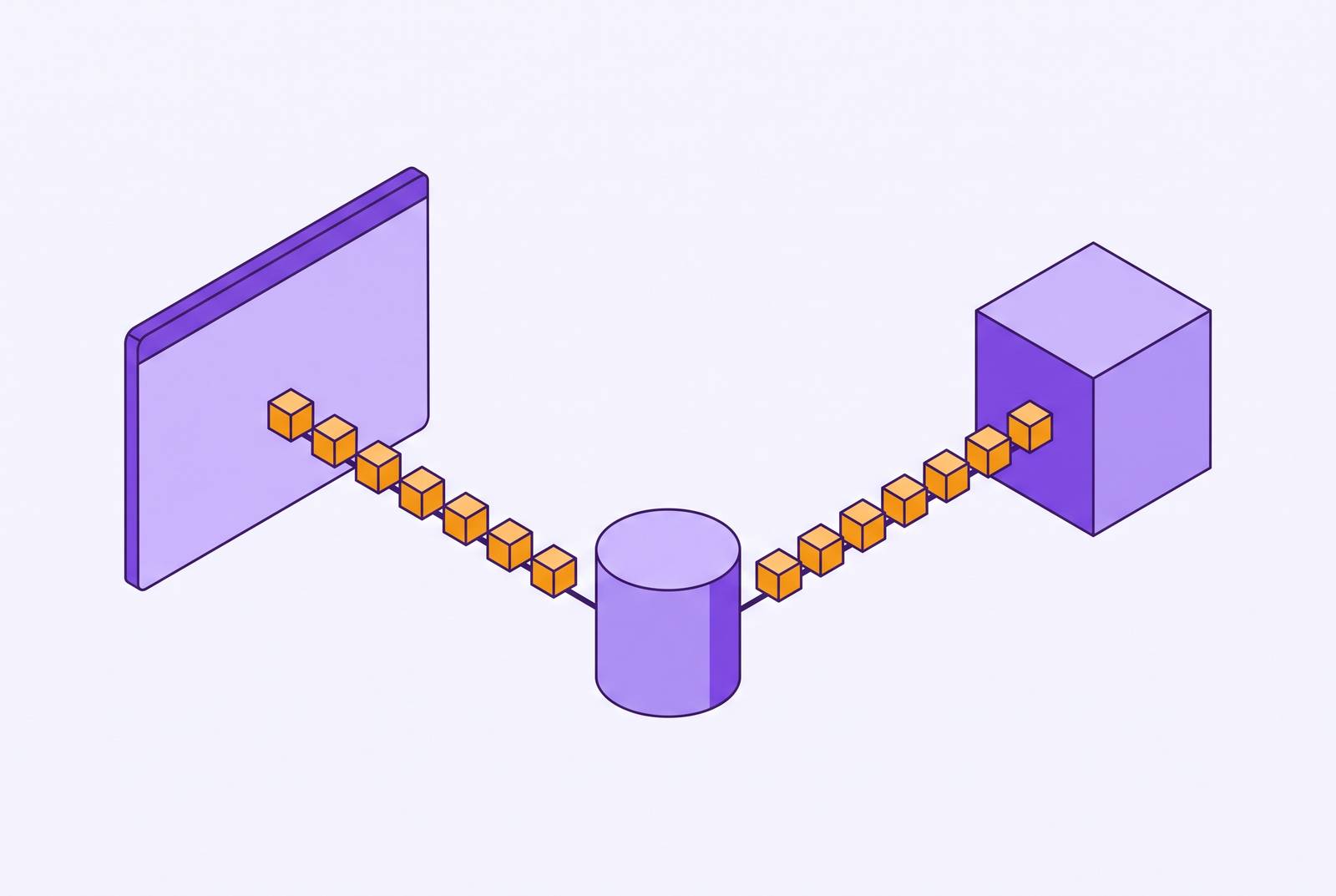
Server-side capture works differently. The event gets detected at the infrastructure layer, the application backend or an API gateway, and a structured payload gets built when the action actually happens. The browser has no say in whether this occurs. An event router, whether a customer data platform or something custom-built, takes the raw event, attaches user context, and sends it wherever it needs to go. Underneath that, message queues buffer events for processing, which keeps tracking separate from the live performance of the app itself.
Most mature SaaS teams end up running both, and for good reason: UI interactions and page behavior stay client-side because that's where real-time feedback lives, while account changes, billing events, and feature completions go server-side because that's where accuracy actually matters. Client-side gives richness and immediacy. Server-side gives completeness and control. Neither substitutes for the other, and a PLG team that treats one as sufficient on its own is already working from a distorted picture.
Why client-side tracking loses events before product teams ever see them
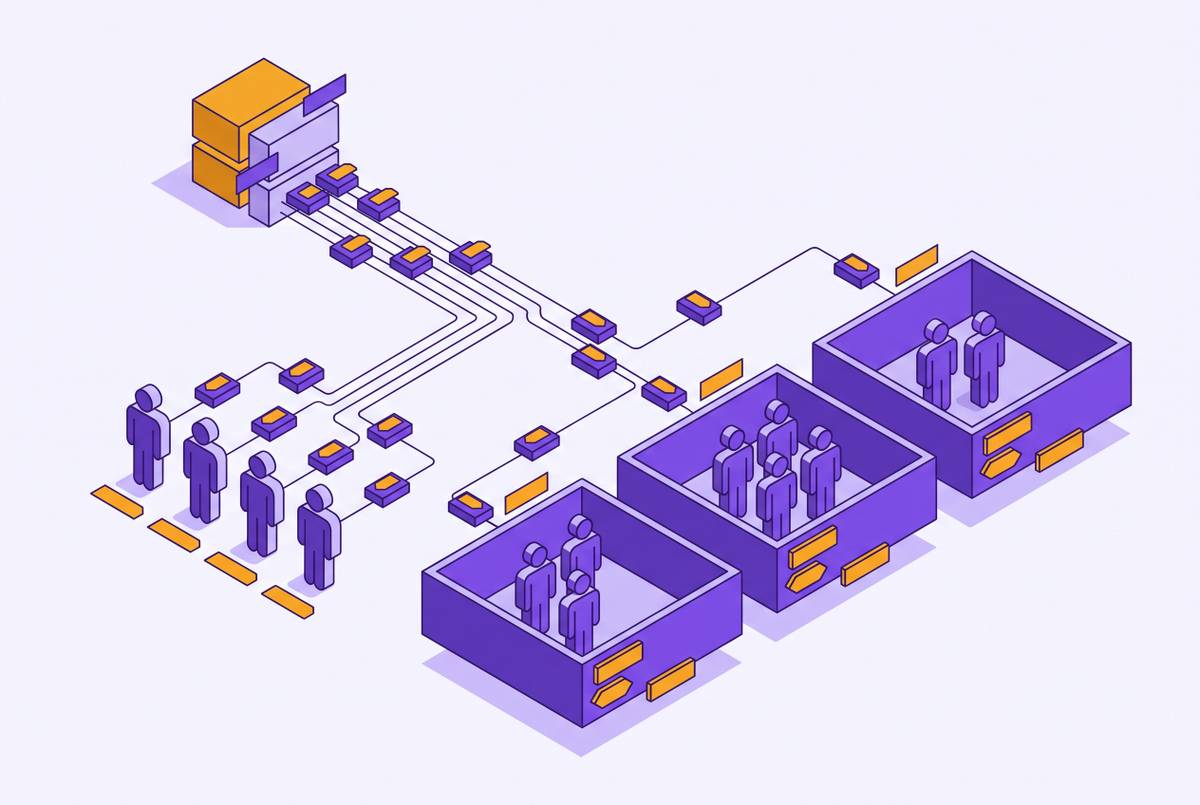
Start with scale. Over a billion people worldwide now run ad blockers, and that number has settled at a high level rather than spiking and fading. For consumer audiences, block rates run in the 25-35% range. For B2B software, the number is worse: developer-facing tools and analytics products aimed at technical buyers face block rates approaching or exceeding half, since software engineers are among the groups most likely to run one, with measured block rates well above average. A developer-tools company measuring its own activation funnel through client-side scripts is, in practice, missing events from the majority of its most technical users. Teams marketing to developers or IT buyers in Europe see even steeper gaps.
This isn't a leak engineering patches once and moves on from. It compounds, for structural reasons, not accidental ones.
The blocking has also moved below the page itself. DNS-level filtering and OS-level content blocking now step in before a script ever loads, so a client-side tag has no way to detect, let alone route around, a DNS resolver quietly dropping requests to an analytics domain. The tag never runs. It never fails loudly enough for anyone to notice.
Browser architecture is speeding up the problem rather than slowing it. Chrome's move away from Manifest V2 extensions, including the removal of tools like uBlock Origin from the Chrome Web Store, has accelerated the shift toward Manifest V3, changing how blocking extensions operate at the browser level. Blocking is increasingly built into network and OS layers, not just optional extensions.
There's collateral damage too. Stack enough third-party tags on a page, a pixel here, an insight tag there, a separate analytics script alongside both, and Total Blocking Time and Largest Contentful Paint start to slip: the same Core Web Vitals metrics tied to search ranking. Slower pages mean more users bounce before any tag fires, stacking event loss on top of whatever the blockers already caught.
Here is the failure mode: a PLG team building activation funnels and feature-adoption curves on client-side data alone may be reading a significantly incomplete sample as the whole population.
What server-side capture recovers, and what it cannot see
Server-side capture recovers a meaningful share of what client-side loses, largely because there's no browser script left for a blocker to intercept. Sending events from the server as first-party data sidesteps almost all conventional blocking. A single request to a first-party endpoint, something like analytics.yourdomain.com, replaces a pile of third-party browser scripts: fewer scripts, faster pages, fewer users bouncing before a tag gets the chance to fire.
For a B2B SaaS data model, the case runs deeper than blocker resistance. Account changes, billing events, permission changes, plan upgrades: these get captured reliably at the backend no matter what the browser is doing. Cross-device continuity holds up too, since server-side identification doesn't lean on cookies that get cleared, blocked, or scoped to a single session. Events can also get enriched with real database state, plan tier, user role, permission level, before they ever reach an analytics tool, something a browser pixel simply has no access to. On the compliance side, sensitive fields can be hashed or stripped server-side before anything leaves for a third-party platform.
None of that makes server-side a full replacement, and pretending otherwise is its own mistake. Scroll depth, session replays, screen resolution: these exist only in the browser's rendering context, and no backend process can rebuild them after the fact. Hover states and in-UI click sequencing live in the same place. Server-side pipelines also add processing lag, so a live dashboard during a feature launch feels a beat slower than its client-side counterpart, and the setup isn't free: server infrastructure, developer time, upkeep. This is not a snippet you paste into a tag manager and walk away from.
Server-side recovers exactly the events that matter most for product and PLG decisions: feature completions, account-state changes, conversion milestones. What it gives up is browser-layer detail that matters more for UX research than for measuring whether a feature actually got adopted.
Why the choice of capture method determines whether PLG metrics are trustworthy
Product-led growth is now the default SaaS model, not an alternative to it. Most software companies run some version of a PLG motion today, and research across thousands of companies has repeatedly named product itself the primary growth channel, ahead of sales and marketing. That shift means in-product behavioral signals aren't a supporting dataset anymore. They're the foundation growth decisions get built on, which raises the stakes on getting capture right by a lot.
There's a real gap between ambition and measurement discipline here. Most PLG companies say they plan to invest more in the motion going forward, yet only a minority actually track activation, the single metric with the strongest claim to predicting whether a free user ever converts to paid. If the activation events feeding that number are getting caught by blockers before they're recorded, the number itself is misleading. Worse than misleading: it's corrupted, and it keeps looking clean while it misleads.
The damage shows up in specific places. Activation funnels get distorted first: technically sophisticated users, the ones most likely to run ad blockers, disproportionately vanish from client-side funnel data, which understates conversion and sends teams chasing fixes to steps that were already working fine. Feature adoption rate takes a second hit, and a worse one, because if the denominator comes from client-side session data and the numerator comes from feature-completion events, both pieces can be incomplete in different directions at once, producing a ratio that doesn't map to anything real in the product.
Pick a side on this: reported activation numbers built on client-side data alone should not be trusted, full stop. With a large share of client-side events dropped specifically among technically sophisticated segments, reported activation lands well below actual activation, which pushes teams to over-invest in activation fixes for a problem that's partly a measurement artifact, not a product defect. Retention numbers carry the same risk one layer downstream: a spread in weekly retention can appear to reflect product quality or onboarding design, when the cohorts underneath that spread were built on incomplete event data in the first place. Capture architecture sits upstream of nearly every product and growth decision a PLG team makes. A flawed foundation doesn't just produce imprecise metrics. It produces metrics that are wrong in a way that looks like signal.
The eligible-cohort problem: how capture gaps distort feature adoption measurement specifically
There's a denominator problem that exists even before capture method enters the picture. If feature adoption gets calculated using every user who logged in, regardless of plan tier, role, or whether they even have access to the feature, the rate understates adoption among the cohort that actually matters. Segmentation has to happen before the math does, and most teams skip this step entirely.
Capture method stacks a second problem directly on top of that one. When client-side events are the source of truth, the eligible cohort itself is often already incomplete, because technically sophisticated users who block scripts get excluded from both the numerator and the denominator, and not evenly. Take a concrete case: if 180 of 600 eligible users complete an adoption action in a given month, the reported rate is 30%. But if a portion of those 600 users run ad blockers and their feature-completion events never get recorded, both the numerator and denominator shift, with no actual change in user behavior underneath it. The number moves. The behavior doesn't.
Activation and adoption are not the same thing, and the distinction matters for how you design capture. Activation means a user encountered a feature once. Adoption means the user came back and used it successfully, more than once. Server-side capture of repeat feature-completion events is what actually separates those two categories in the data. A browser pixel that fires cleanly on first visit but gets blocked on the second creates a false ceiling on adoption, one that looks like users trying a feature once and abandoning it, when in fact they're returning to it every week without any of those events getting logged.
That repeat-use signal carries real predictive weight: features that get used repeatedly within the first week of exposure show meaningfully stronger retention at the 90-day mark than features that don't. That correlation is invisible if repeat-use events are getting silently dropped, even while the underlying behavior keeps happening in the product every day. Top-quartile companies clear roughly double the adoption rate of the average, and that gap is exactly where teams compete for growth. Competing on corrupted data means optimizing for the wrong fix entirely.
Compliance and privacy constraints that make capture method a legal question, not just a technical one
GDPR turns capture architecture into a legal question, not just an engineering one, and treating it as purely a technical decision is a mistake with regulatory teeth. Client-side tracking needs a valid legal basis, a valid legal basis before it can collect personal data at all. A single "reject all" click removes that legal basis for that user entirely, layering a consent-based gap on top of whatever technical data loss the blockers were already causing. The two failures compound rather than offset.
Server-side capture gives teams a genuine advantage here, because sensitive fields, PII, device identifiers, can be hashed, filtered, or stripped before anything leaves for a third-party platform. The server becomes the actual control point. The browser stops being one. Client-side implementations, by contrast, typically run several vendor scripts at once, each with independent access to whatever user data passes through it, which multiplies the number of places something can go wrong. Server-side consolidates that into a single, controlled stream a team can actually audit.
European exposure sits at the intersection of a strict regulatory environment and elevated ad-blocker rates, which means B2B SaaS companies with European customers face both pressures at once, not one after the other. Cross-device tracking adds a further wrinkle: server-side identification is not dependent on browser cookie state in the way client-side tracking is, which matters both for compliance and for continuity, since the same B2B user often switches devices or clears cookies without switching identity.
Here's the practical upshot: compliance requirements can force a company to build server-side infrastructure before any data-quality argument ever gets raised internally. Once that infrastructure exists for legal reasons, it fixes the ad-blocker data-loss problem as a side effect, essentially for free.
How to think about which events belong on which side of the architecture
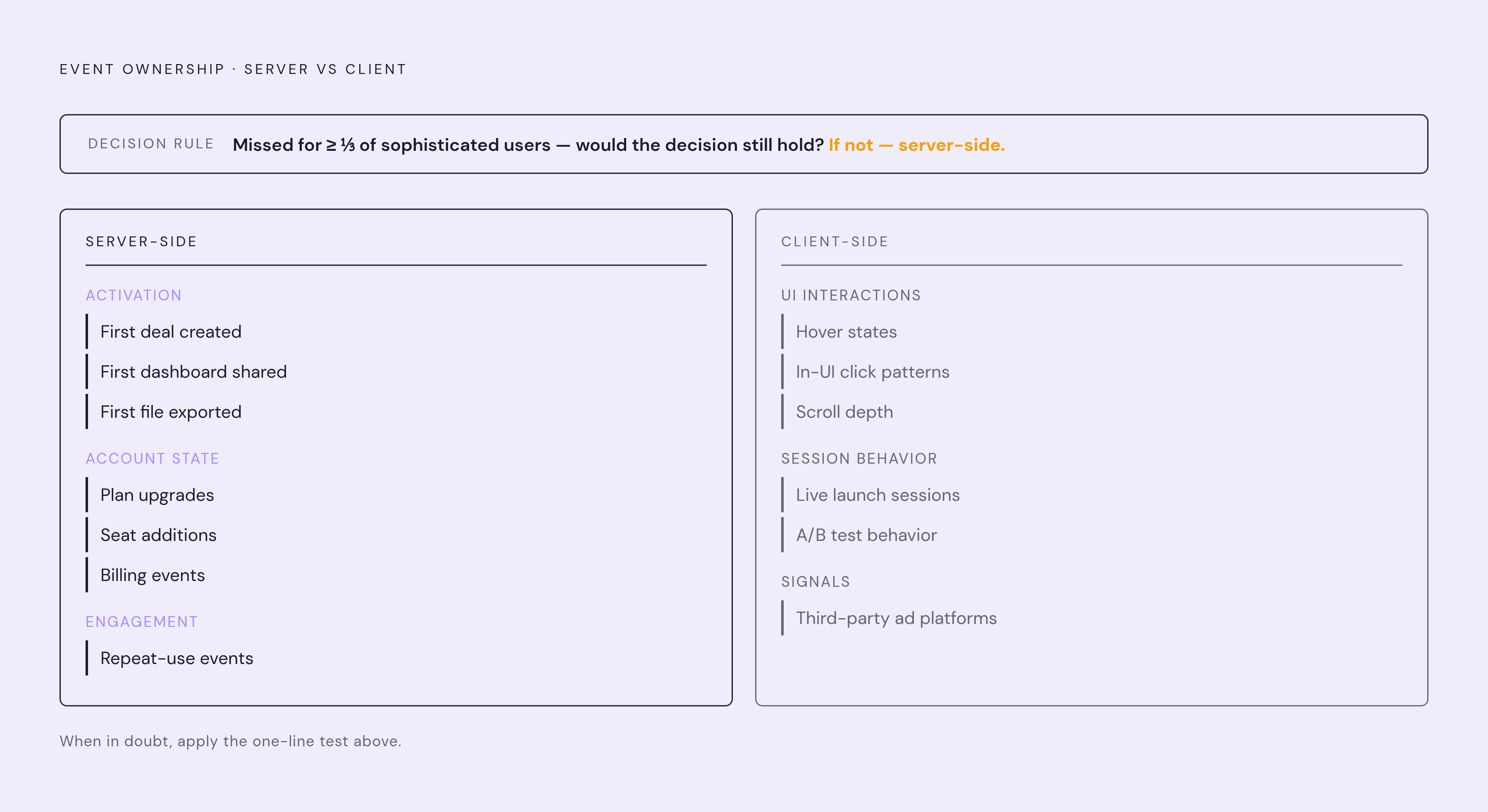
The partitioning rule is simple to state, harder to hold to consistently: put each event on whichever layer captures it most completely, given what the event actually gets used for downstream. Not every event deserves the same treatment, and trying to run everything through one pipe is where teams go wrong.
Certain events belong server-side without much argument. Feature completions that define activation, a first deal created, a first dashboard shared, a first file exported, are the events onboarding sequences and adoption measurement get built on, and they need reliability client-side simply can't promise. Account-level state changes, plan upgrades, permission changes, seat additions, billing events, are financial and contractual data that should never depend on whether a browser pixel happened to fire that day. Repeat-use events matter just as much, since that's the exact signal separating real adoption from a one-time activation. Airtable's product team, in an account written up for Lenny's Newsletter by Lauryn Isford, defined activation as multi-user collaboration happening within a user's fourth week, and rebuilding onboarding around that milestone produced roughly a 20% lift in activation. A milestone that specific only holds up if the underlying event fires reliably every time, which means it belongs server-side.
Other events are fine staying client-side. Real-time UI interactions, hover states, in-UI click patterns, scroll depth, are UX research signals that need browser context to exist at all, and they can tolerate some incompleteness without corrupting a downstream growth decision. Session-level behavior during live launches or A/B tests, where immediate feedback matters more than perfect completeness, fits here too. Third-party ad platforms often require client-side signals by their own design, with server-side data serving as a supplement rather than a full swap.
Calendly is a clean example of designing around this line. According to the company's chief product officer, Stephen Hsu, Calendly's activation moment centers on getting meetings booked, specifically five meetings booked within a defined window. The event recording that milestone triggers the product's follow-on guidance to users, and it has to be server-side so it fires reliably no matter what the user's browser is doing that day.
There's a signal hierarchy worth keeping for onboarding sequences generally: in-product event completion first, click-through second, open rate a distant third, especially now that Apple's Mail Privacy Protection has made open-rate data close to useless as a standalone signal. That hierarchy only holds, though, if the in-product events sitting at the top of it are actually getting captured in the first place.
One test cuts through most of the ambiguity: if this event were missed for a third or more of technically sophisticated users, would the decision built on it still hold up? If not, it belongs server-side. No exceptions worth carving out.
The infrastructure and organizational cost of getting server-side capture right
Server-side capture is not a drop-in replacement for a tag manager snippet, and treating it as one is where a lot of implementations quietly fail. It takes real server infrastructure, developer time to build and maintain an event pipeline, and API connections into whatever analytics or customer data platforms sit downstream. Anyone pitching it as a quick swap hasn't run the migration themselves.
That pipeline has several layers, and each one needs an owner. The capture layer, the application backend or API gateway, has to detect meaningful actions and build structured payloads when they happen. The routing layer, middleware or a CDP, takes those raw events, transforms and enriches them, and sends them to the right destinations. Underneath both sits a buffer layer, a queue like Kafka or Kinesis, handling processing at scale and keeping tracking separate from the app's own performance.
None of this runs itself once it's built. Server infrastructure needs regular upkeep: schema changes, new event types, downstream integrations that shift over time. Client-side tracking, once deployed through a tag manager, needs comparatively little ongoing attention by comparison. Server-side setups can also be harder to wire into third-party marketing tools built around a client-side data model from the start, and the lag trade-off is real: a live dashboard during a campaign launch feels less immediate than its client-side counterpart.
There's an organizational cost stacked on top of the technical one, and it's often the harder one to clear. Moving critical events to server-side capture usually means pulling product engineering into a decision that used to live entirely with marketing or analytics, and that coordination overhead adds to the infrastructure cost rather than replacing it.
Still, the payoff justifies the lift. PLG companies grow substantially faster than sales-led peers while burning meaningfully less cash to get there, according to OpenView's research on the category. That advantage only shows up if the metrics steering the PLG motion, activation, adoption, retention, are built on events that were actually captured, not on whatever fraction happened to survive a browser's ad blocker that day.
Sources
- Client-Side Vs. Server-Side Analytics: Full Guide
- Server-Side vs Client-Side Tracking: A Simple Guide | Snowplow Blog
- What is Server-Side Analytics and Tracking? - Salespanel Blog
- Server-side vs client-side tracking: Key differences and when to use each
- trackraptor.com
- Server-side vs client-side event tracking
- Server-side tracking for data accuracy in 2026 | Trackingplan
- Server-side tracking: the complete guide for marketers | iubenda